
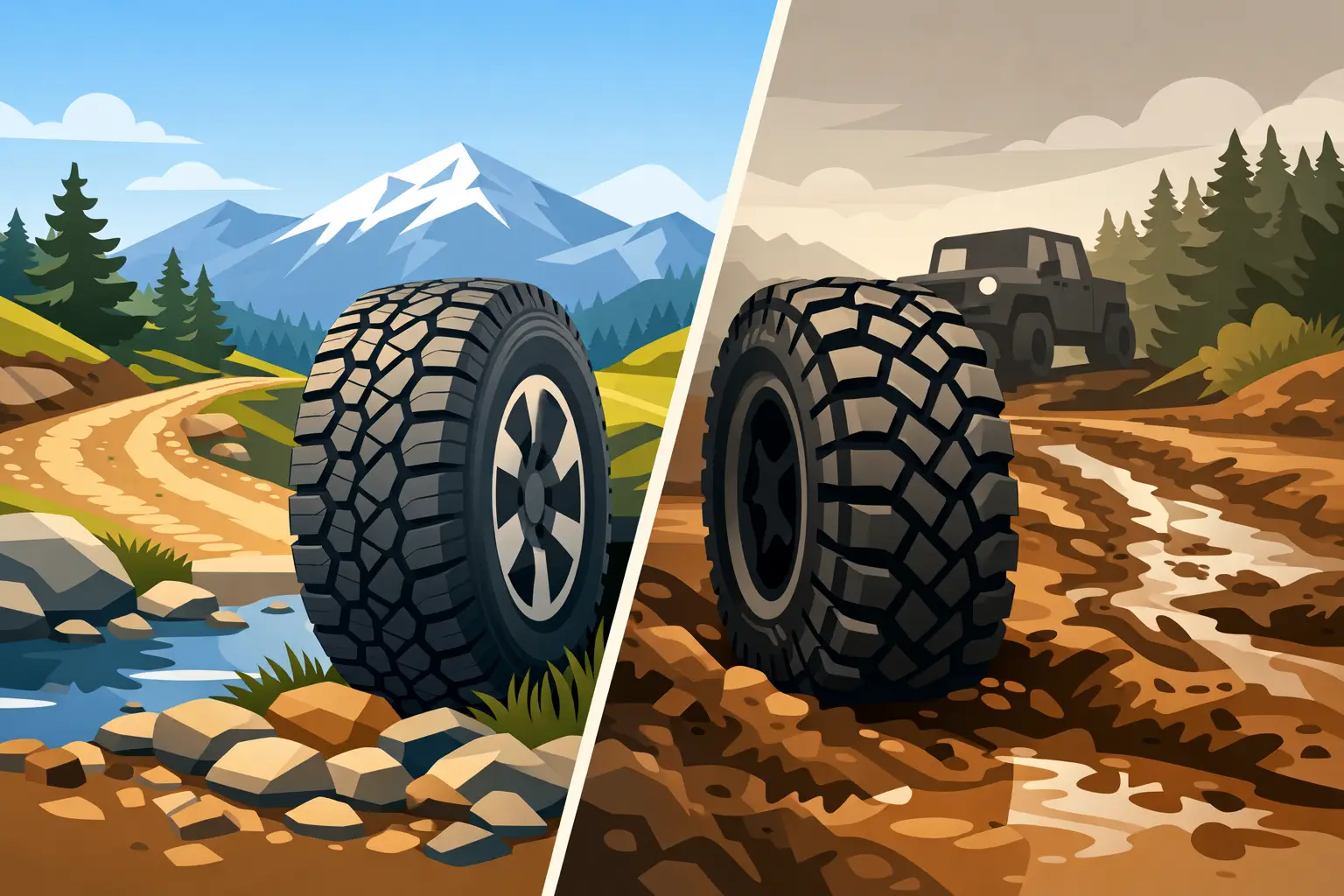
You feel the difference before you even look at the tread. One tire hums on the highway, tracks clean in rain, and still handles a fire road on the weekend. The other announces itself with deeper voids, heavier lugs, and a clear message: it was built for mud first. When comparing all terrain vs mud tires, the right choice comes down to where your vehicle actually spends its time, and how much compromise you are willing to accept on pavement.
For truck, Jeep, and SUV owners, this is not just a styling decision. Tire choice changes braking feel, steering response, cabin noise, fuel economy, tread life, and off-road confidence. Aggressive sidewalls may look right at home under a lifted setup, but the best-looking tire is not always the best-performing one for your daily route.
All terrain vs mud tires: the real difference
At a glance, both tire types look more capable than a standard highway tire. The gap shows up in tread design and how that design behaves across different surfaces.
All-terrain tires are built to cover mixed use. They usually have tighter tread blocks than mud-terrain tires, smaller voids between lugs, and a pattern meant to keep enough rubber in contact with the road. That gives them more predictable on-road manners while still delivering solid traction on gravel, dirt, light mud, sand, and snow.
Mud-terrain tires are more specialized. They use larger tread blocks, deeper voids, and a more open pattern that helps eject mud rather than pack it in. Many also feature reinforced sidewalls and more aggressive shoulder lugs for better grip in ruts, rocks, and sloppy terrain. The trade-off is simple: the same design that bites harder off-road tends to ride rougher and sound louder on pavement.
If your truck is a commuter five days a week and a trail rig twice a month, all-terrain usually makes more sense. If your build regularly sees deep mud, soft ground, and low-speed technical trails, mud-terrain starts to justify its compromises.
Where all-terrain tires make the most sense
All-terrain tires are the better fit for most drivers because most drivers spend most of their miles on pavement. That does not make them soft or limited. A quality all-terrain tire can handle gravel roads, hunting land, construction access roads, forest trails, and moderate weather without turning the daily drive into a penalty.
The biggest advantage is balance. You get better ride comfort, lower road noise, and typically longer tread life than you would with mud tires. On wet pavement, many all-terrain tires also feel more composed because they keep more tread in contact with the surface. Steering is usually more stable, especially at highway speed.
This matters if your vehicle pulls double duty. A half-ton pickup that tows on weekends, a Jeep that sees commuting and camping, or an SUV that handles family miles plus seasonal backroads will often benefit more from an all-terrain setup than a mud-focused one.
There is also the winter question. Some all-terrain tires perform surprisingly well in snow, especially models designed with severe snow capability in mind. Mud-terrain tires can claw through loose slop, but they are not automatically better on packed snow or icy pavement. A more aggressive tread does not always mean a safer tire in winter driving.
When mud tires are worth it
Mud-terrain tires earn their place when the terrain is consistently loose, wet, uneven, and demanding. Deep mud is the obvious example, but they also shine in rocky trails, heavily rutted ground, and off-road conditions where sidewall strength and self-cleaning tread matter more than road comfort.
The open tread pattern helps the tire shed mud as it rotates. That keeps the lugs working instead of turning into smooth, packed rollers. On technical trails, the larger tread blocks and stronger carcass can offer better bite and more durability against cuts and punctures.
If your vehicle is built around off-road use, the noise and wear can be acceptable costs. For example, a weekend trail Jeep, a ranch truck that spends more time in wet fields than on interstate miles, or a purpose-built overland setup used in rough terrain may genuinely need mud tires.
The mistake is buying them for the look alone without accounting for the daily cost. Mud tires can be louder from day one and may get louder as they wear. They often weigh more, which can affect acceleration, braking, and fuel economy. Depending on the tire and rotation schedule, tread wear may also happen faster than expected.
On-road behavior: where most buyers feel the difference
This is where the debate usually gets settled. In normal driving, all-terrain tires are easier to live with.
They tend to track straighter, ride smoother, and create less vibration through the steering wheel and cabin. Road noise is generally lower, especially at highway speeds. For drivers who spend hours commuting, towing, or covering long interstate miles, that comfort adds up quickly.
Mud tires can still be street legal and roadworthy, but they usually ask for more tolerance. Expect more hum, a heavier feel, and sometimes less precise steering response. Braking distances on wet roads can also be a concern depending on the compound and tread design. Not every mud tire behaves poorly on pavement, but very few match a good all-terrain tire for all-around street manners.
Off-road traction: not all dirt is the same
A lot of buyers think off-road use automatically means mud tires. That is too broad.
On gravel, hard-packed dirt, and mixed-use trails, all-terrain tires often perform extremely well. They can conform better to varied surfaces while preserving decent control and stability. In sand, a less aggressive tread can sometimes be an advantage if aired down properly, because it helps the tire float rather than dig.
Mud tires take over once the terrain gets deeper and messier. Thick mud, slick ruts, and jagged rock gardens are where their tread pattern and sidewall design start paying off. If your tire is repeatedly getting clogged and losing traction in those conditions, that is usually the sign that an all-terrain tire is being pushed past its ideal use case.
Cost, tread life, and daily value
Tire pricing varies by size and brand, but mud-terrain tires are often more expensive to buy and more expensive to live with. Their aggressive tread can wear faster, and their extra weight may chip away at fuel economy. Some drivers also end up replacing suspension or steering components sooner when heavier wheel-and-tire packages become part of the build.
All-terrain tires usually offer better long-term value for mixed-use drivers. They tend to last longer, create less fatigue on long drives, and deliver stronger everyday versatility. If you are trying to get the most use out of one set of tires year-round, all-terrain is typically the more efficient purchase.
That said, value is about fitment, not just lifespan. A mud tire that gets you through the terrain you actually drive is a better value than an all-terrain tire that leaves you stuck.
How to choose between all terrain vs mud tires
Start with an honest split of your mileage. If 70 to 80 percent of your driving happens on pavement, all-terrain is usually the smarter answer. If your vehicle regularly sees deep mud, trail obstacles, and low-speed off-road work where traction is the priority, mud-terrain deserves a serious look.
Then think about your tolerance for compromise. Are you fine with more noise for more off-road grip? Do you care about clean highway tracking, wet-road confidence, and lower rolling resistance? Be realistic. A tire can be capable and still be wrong for your day-to-day use.
Vehicle type matters too. A lightly modified SUV used for commuting and outdoor trips has different needs than a lifted Jeep on beadlocks or a diesel truck working on rough land. Matching the tire to the job will always outperform choosing based on appearance alone.
Finally, consider your full setup. Wheel size, load rating, suspension geometry, and tire pressure all affect performance. The right tread pattern works best when the rest of the package makes sense. That is where a product-focused retailer like FORTLUFT fits the modern buyer – capability, fitment, and style should work together, not compete.
The better tire is the one that matches your real miles
There is no universal winner in all terrain vs mud tires. There is only the better match for how your truck, Jeep, or SUV is used. If you want broad capability with stronger on-road behavior, all-terrain is the proven choice. If your route includes serious mud and rough trail conditions often enough to justify the trade-offs, mud tires are doing exactly what they were built to do.
Choose for the miles you actually drive, not the image you want to project. A tire that fits your terrain, your vehicle, and your expectations will always look better once the road runs out.