
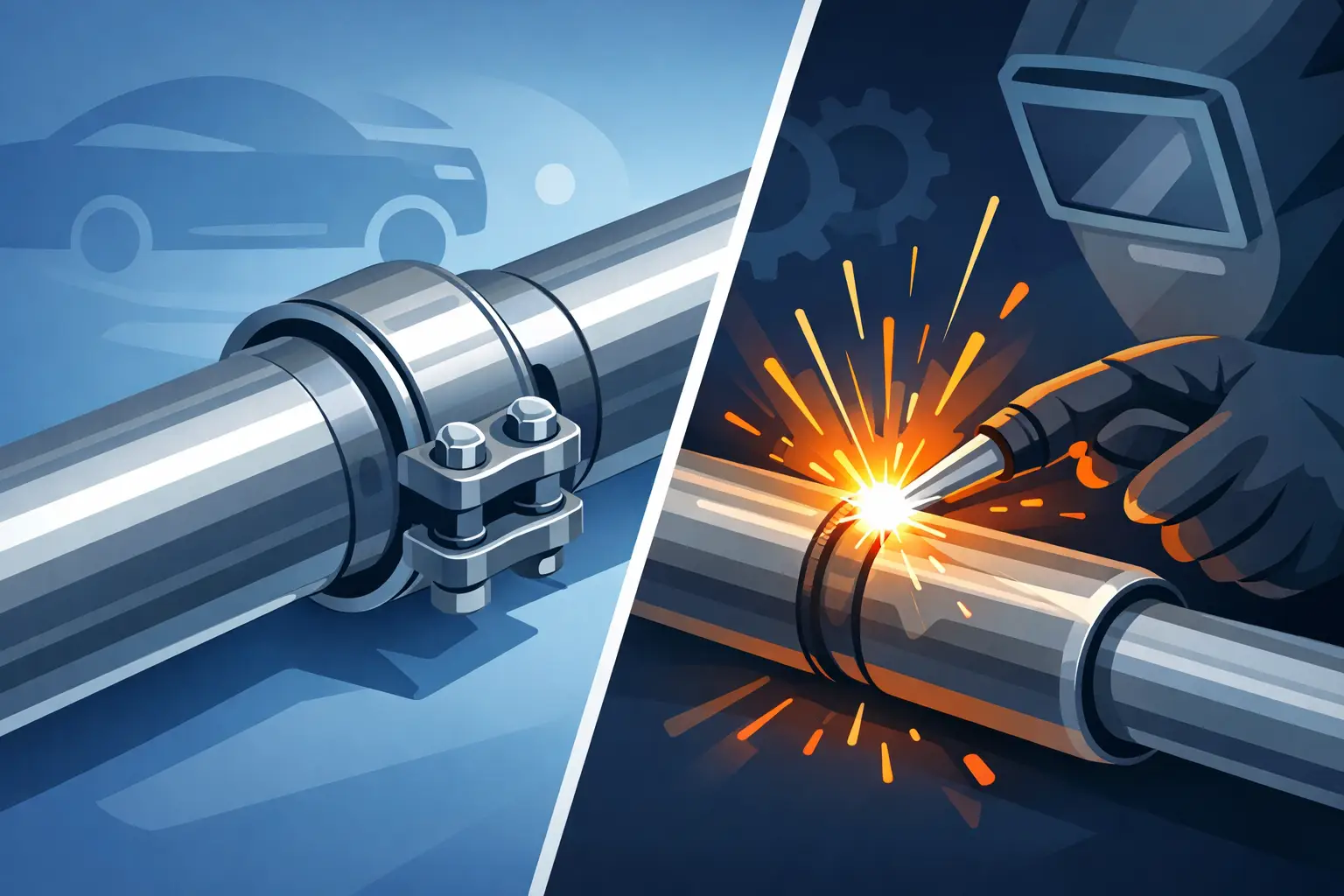
A loose exhaust joint can turn a clean-running vehicle into one that rattles, leaks, and sounds unfinished. The exhaust clamp vs welding decision is not simply about the cheapest fix. It affects how well the system seals, how easily it can be serviced later, and whether the finished exhaust looks as intentional as the rest of the build.
For a daily driver, truck, Jeep, or modified SUV, the right answer depends on the pipe condition, the joint style, the material, and your plans for the vehicle. A clamp can be a smart, durable service solution. Welding can create a permanent, factory-like connection. Choosing between them starts with knowing what each method actually does well.
When an Exhaust Clamp Is the Better Choice
An exhaust clamp secures two correctly sized components together without permanently joining them. It is commonly used on slip-fit pipes, muffler connections, catalytic converter sections, resonators, and replacement components designed for bolt-on installation.
The biggest advantage is serviceability. If a muffler, resonator, or pipe section needs replacement later, a clamped connection can usually be separated without cutting the exhaust apart. This matters on vehicles that see regular maintenance, off-road use, seasonal modifications, or future exhaust upgrades.
Clamps also make sense when the exhaust is being test-fitted. A performance system may need small adjustments to hanger position, tip alignment, clearance around the axle, or distance from a bumper cutout. A clamp allows that adjustment before the installation is finalized. For appearance-focused builds, being able to center a stainless steel or carbon fiber tip precisely is a practical advantage.
Not all clamps perform the same way. A basic U-bolt clamp is affordable and widely available, but it can deform thinner pipe and may make disassembly difficult after heat cycles. Band clamps distribute clamping force more evenly around the pipe, helping create a cleaner seal with less distortion. Lap-joint band clamps work well where one pipe slips over another, while butt-joint band clamps are intended for two same-diameter pipe ends meeting edge to edge.
A clamp is only as good as the fitment beneath it. The pipe surfaces need to be round, clean, and correctly sized. If the ends are crushed, heavily rusted, split, or mismatched, tightening a clamp harder will not create a dependable seal. Exhaust paste may help with minor imperfections in some applications, but it is not a substitute for sound pipe material and proper overlap.
When Welding an Exhaust Makes More Sense
Welding creates a permanent metal-to-metal joint. Done correctly, it can provide excellent strength, a compact profile, and a clean finished appearance. It is often the better option for custom exhaust fabrication, sections with limited clearance, or joints that repeatedly move or leak under clamp pressure.
A welded joint can be especially useful when the exhaust routing has been modified. If tubing is cut and fitted around a suspension component, crossmember, skid plate, or custom bumper, welding locks the fabricated pieces in their exact positions. It also eliminates the bulk of a clamp, which can be valuable when clearance is tight.
For high-heat or high-vibration applications, a properly welded connection may hold its position better than a poorly selected clamp. That does not mean every welded exhaust is automatically better. Weld quality, material preparation, filler choice, and the welder’s technique all matter. A rushed weld on dirty or thin metal can crack, leak, or create a restriction just as surely as a bad clamp installation.
Welding is also less forgiving when future repairs are needed. If a catalytic converter, muffler, or pipe section fails, a welded system often must be cut apart before replacement parts can be installed. That can add labor and reduce the usable length of the remaining tubing. On a vehicle you expect to maintain for years, permanent joints should be chosen with that future work in mind.
Material compatibility deserves attention as well. Mild steel is common on factory-style replacement systems and can be welded effectively, but corrosion eventually becomes a concern in wet and salted-road environments. Stainless steel offers stronger corrosion resistance and a more refined finish, yet it requires suitable welding technique and compatible filler material. Mixing metals without considering the joint can lead to premature corrosion or an uneven repair.
Exhaust Clamp vs Welding: How to Choose
Start with the condition of the existing system. If the surrounding pipe is solid and the replacement part has a proper slip-fit connection, a quality band clamp is often the direct, practical choice. It provides a secure installation while keeping the system easier to service.
If the pipe is damaged near the connection, has an irregular diameter, or requires custom fabrication to fit correctly, welding may be the more reliable route. The same applies when a joint sits where a clamp would interfere with chassis clearance, suspension travel, or a heat shield.
Consider how permanent the work should be. A clamp suits components that may be removed later, including mufflers, resonators, adjustable exhaust sections, and replaceable tips. Welding suits sections that are intended to stay in place, particularly custom mid-pipes and carefully fabricated bends.
Cost has two sides. Clamps generally reduce upfront labor because they can be installed with basic hand tools. Welding requires equipment or professional labor, but it can prevent repeat repairs if it solves a persistent fitment issue. The lowest initial price is not always the lowest long-term cost.
Use this quick decision check before buying parts or scheduling work:
- Choose a clamp for properly sized slip-fit components, future service access, and straightforward replacement work.
- Choose welding for custom fabrication, damaged pipe ends, limited clearance, or a permanent connection.
- Choose a quality band clamp over a basic U-bolt clamp when clean sealing and easier future removal are priorities.
- Replace compromised tubing rather than relying on either method to compensate for severe rust, cracking, or distortion.
Fitment and Installation Details That Prevent Leaks
Whether clamping or welding, alignment determines the outcome. Support the exhaust at its natural hanger locations before tightening or welding anything. An exhaust system that is forced into position can preload the hangers, transmit vibration into the cabin, and place stress on joints as the system expands with heat.
For clamped joints, clean away loose scale and inspect the pipe diameter. Confirm the required overlap for a slip-fit connection, then position the clamp over the actual joint rather than at the end of one pipe. Tighten evenly to the clamp manufacturer’s specification. After a full heat cycle, inspect for soot marks, listen for ticking, and recheck torque if the clamp design calls for it.
For welding, remove coatings, rust, and contamination from the weld area. Tack the assembly in multiple places first, then verify tip alignment, hanger tension, and clearance before completing the weld. A professional installer should also account for heat near oxygen sensors, wiring, fuel lines, and underbody components. Welding near a catalytic converter or other emissions component requires extra care to avoid damage.
Do not overlook exhaust movement. Pipes expand when hot, and the system needs properly placed hangers and enough clearance from heat-sensitive parts. A weld may be structurally sound but still fail if the exhaust is hitting a crossmember or the engine’s movement is being transferred into a rigid section.
Build for the Way You Use Your Vehicle
There is no universal winner between clamps and welds. A well-selected clamp can be the right professional repair, not a shortcut. A quality weld can be the right upgrade, not an unnecessary permanent commitment. The best method matches the component design and the vehicle’s real use.
For replacement work, prioritize fitment, sealing surface, and service access. For a custom system, prioritize routing, material quality, clearance, and the finish you want behind the vehicle. FORTLUFT exhaust components and tips are designed for owners who expect both function and a considered final look. Choose the joint that lets your exhaust perform cleanly now while leaving you with a system you can maintain with confidence later.