
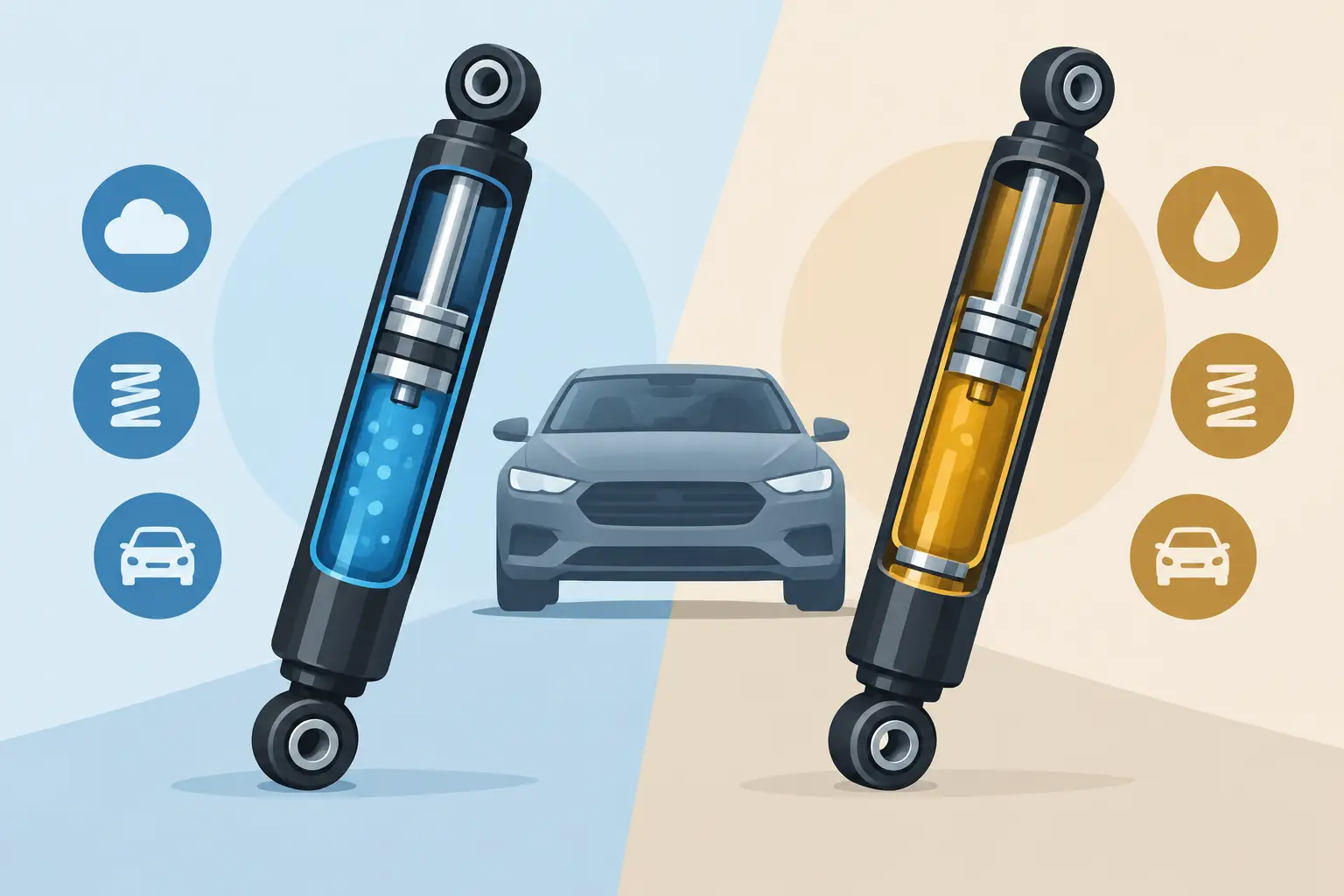
A shock absorber has a short, demanding job: control spring movement every time your tire meets a crack, pothole, expansion joint, trail obstacle, or loaded trailer. In the gas shocks vs oil shocks decision, the right answer is not simply “firmer” or “softer.” It comes down to how you use the vehicle, how much weight it carries, and how controlled you want it to feel when the road gets rough.
For a commuter sedan, a conventional oil shock may provide the composed, comfortable response you expect. For a truck that sees cargo, towing, washboard roads, or larger tires, gas-charged shocks can offer stronger, more consistent control. Understanding the difference helps you buy suspension parts for the vehicle you actually drive, not just the product description that sounds best.
What Shocks Actually Do
Shocks do not support the vehicle’s weight. Springs, torsion bars, or air springs handle that job. The shock absorber controls the speed at which the suspension compresses and rebounds. Without adequate damping, the vehicle continues to bounce after a bump, the tires lose contact with the pavement, braking stability suffers, and steering can feel loose or delayed.
Inside the shock, a piston moves through hydraulic fluid. Valves regulate that fluid flow to resist suspension movement. That resistance is damping. The design of those valves, the size of the shock, and the fluid and gas arrangement all influence how the vehicle responds.
A worn shock can make a good tire and wheel setup feel disappointing. If your SUV dives under braking, your truck porpoises after a dip in the road, or your Jeep feels unsettled through a long curve, damping may be part of the problem.
Gas Shocks vs Oil Shocks: The Real Difference
The term “oil shock” usually describes a conventional hydraulic shock that relies primarily on oil for damping. A gas shock also uses hydraulic oil, but it adds pressurized nitrogen gas. It is not a choice between gas or oil as separate damping methods. Both designs use oil. The gas charge changes how the shock manages that oil during repeated movement.
As a shock cycles, heat builds and the oil can aerate, meaning tiny air bubbles form in the fluid. Aerated oil is easier to compress and can reduce damping consistency. This condition is often called shock fade. Nitrogen pressure helps limit foaming and cavitation, allowing the shock to deliver more predictable damping when it is working hard.
That distinction matters most when the suspension cycles repeatedly or carries more load. A vehicle cruising a smooth highway may not expose much difference. A pickup crossing broken pavement with a bed full of tools, however, can make the advantage obvious.
Conventional hydraulic oil shocks
Oil shocks are often associated with a more compliant ride. With lower internal pressure, they can feel less aggressive over small, sharp imperfections. They are a sensible option for stock-height cars and light-duty vehicles used mainly for normal street driving, especially when ride comfort is the priority.
They can also be an economical replacement when the original suspension tuning was comfort-focused. That does not make them inferior. A properly valved hydraulic shock can perform well for its intended application. The trade-off is that its damping may become less consistent during extended rough-road use, higher-speed driving, or heavy loading.
Gas-charged shocks
Gas-charged shocks use nitrogen pressure to keep the hydraulic fluid stable. They are commonly available in twin-tube and monotube configurations. Twin-tube gas shocks are widely used for replacement applications, while monotube units often provide greater heat capacity and more immediate response for demanding use.
On the road, gas shocks can feel more controlled and precise. Body motion is usually better managed through corners, after braking, and when the vehicle encounters repeated bumps. They are often a strong match for trucks, Jeeps, SUVs, work vehicles, towing applications, and drivers who want a more planted feel.
The trade-off is ride character. A gas-charged shock with firm valving can transmit more road texture into the cabin than a comfort-oriented hydraulic unit. That is not automatically a harsh ride, but it is a different calibration. The best shock is the one whose damping matches the vehicle weight, springs, tire sidewall, and intended use.
Ride Quality Is More Than Soft or Stiff
A common mistake is assuming gas shocks are always stiff and oil shocks are always soft. Shock construction influences feel, but valving is equally important. Two gas shocks can feel dramatically different if one is built for a stock crossover and the other for a lifted off-road truck.
Tire choice also changes the equation. Large all-terrain tires with flexible sidewalls can add movement that benefits from confident damping. Low-profile street tires can make any firm suspension feel sharper over broken pavement. Lift kits, leveling kits, heavier bumpers, winches, roof racks, and bed accessories add weight or alter suspension geometry, which may call for shocks designed for the new setup.
If your vehicle is stock and primarily handles commuting, choose a quality replacement shock designed around original ride characteristics. If it regularly tows, hauls, travels unpaved roads, or runs aftermarket suspension components, look for a gas-charged option matched to that workload.
Choosing Shocks by Vehicle Use
For daily-driven cars and crossovers, refinement matters. A comfort-focused hydraulic or low-pressure gas shock can keep the ride controlled without making every pavement seam noticeable. Prioritize correct fitment and OE-style travel over an overly aggressive performance spec.
For trucks and full-size SUVs, gas shocks are frequently the practical choice. Payload changes, trailer tongue weight, long wheelbases, and larger tires all place greater demands on damping. A quality gas shock helps the vehicle settle more quickly after a bump and can reduce the floating sensation that develops with tired factory units.
For Jeeps and off-road builds, the decision depends on terrain and suspension travel. A gas-charged shock is useful for repeated articulation and rough surfaces because it resists fade. However, length is critical. A shock that is too short can bottom out before the suspension does; one that is too long can overextend at full droop. Lift height alone is not enough – confirm compressed length, extended length, mounting style, and available travel.
For towing and commercial work, avoid choosing solely by brand or price. Consider loaded vehicle weight, trailer use, road conditions, and how often the vehicle operates under load. Shocks cannot compensate for undersized springs, overloaded payload, or improper weight distribution, but the correct gas-charged units can make a properly set up vehicle noticeably more stable.
When Replacement Is Due
A leaking shock is an obvious warning, but it is not the only one. Gradual wear can be harder to spot because drivers adapt to the change. Excessive bounce after a dip, front-end dive, rear-end squat and rebound, uneven tire cupping, steering correction in crosswinds, and instability over rough pavement are all reasons to inspect the suspension.
Replace shocks in pairs on the same axle so left and right damping remain balanced. Check related wear items at the same time, including shock mounts, bushings, boots, control arm bushings, ball joints, and tire condition. Fresh shocks cannot deliver their best result if mounting hardware is worn or the tires are out of balance.
For strut-equipped vehicles, remember that a strut is a structural suspension component, not just a shock absorber. The same damping principles apply, but installation and alignment requirements may be different.
Buy for Fitment, Then for Feel
The cleanest way to decide between gas shocks and oil shocks is to start with exact vehicle fitment. Verify year, make, model, drivetrain, trim, ride height, and any suspension modifications. Then choose the shock category that suits how the vehicle works: comfort-focused street use, daily driving with occasional load, heavy-duty hauling, performance handling, or off-road travel.
At FORTLUFT, that approach aligns with choosing parts that serve both function and the character of the build. A well-matched shock does more than remove bounce. It makes the stance, tire package, and suspension upgrades feel intentional from the driver’s seat.
Do not chase the firmest option just because it sounds performance-oriented. Choose damping that keeps your tires connected, your load stable, and your vehicle predictable. That is where suspension technology becomes something you can feel on every mile.