
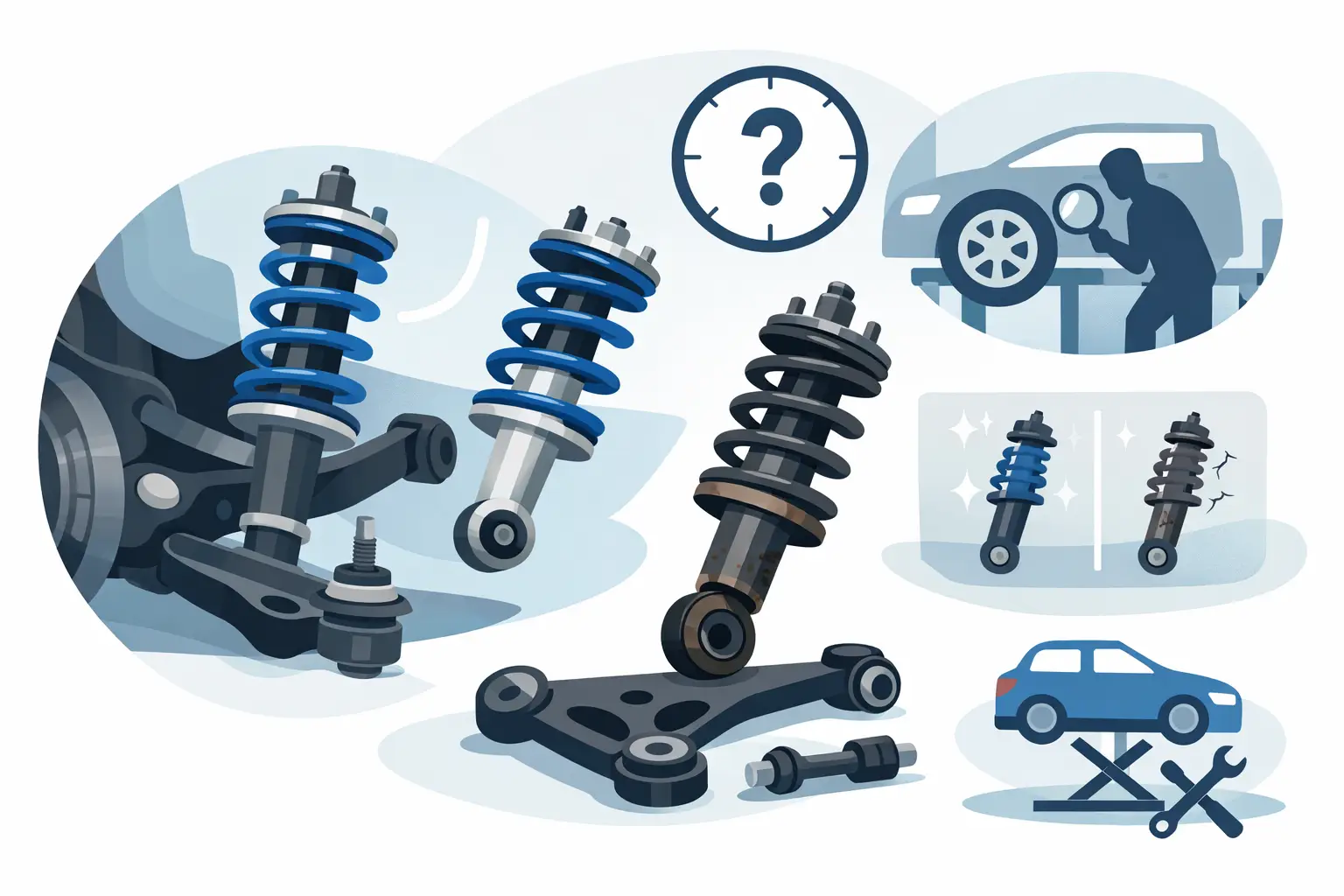
A vehicle that suddenly feels loose in corners, crashes harder over potholes, or starts wearing out tires faster than expected is usually telling you something. If you’re asking when should suspension parts be replaced, the real answer starts with condition, mileage, and how the vehicle is used – not a single universal number.
Suspension parts do not all wear at the same rate. Shocks and struts can fade gradually enough that drivers adapt to the change without noticing it right away. Ball joints, control arm bushings, sway bar links, and tie rod ends often show wear in different ways, from clunks and wandering steering to uneven tire wear and poor braking stability. On trucks, Jeeps, and SUVs that see rough roads, towing, or off-road use, that timeline can move up faster.
When should suspension parts be replaced based on mileage?
Mileage is a useful starting point, but it is not a diagnosis. Many suspension components begin to lose performance somewhere around 50,000 to 100,000 miles, especially shocks and struts. That does not mean every part is bad at 60,000 miles or perfect at 95,000. It means inspection becomes more important as miles add up.
Shocks and struts usually live in the gray area between still working and working well. They may not leak, fail, or make noise, but they can lose damping force over time. The vehicle still drives, yet body motion increases, braking distances can grow, and the tires may spend less time planted evenly on the road.
Other parts are more sensitive to environment than mileage alone. Bushings dry out, crack, or deform from age, heat, road salt, and oil contamination. Ball joints and tie rod ends can develop play from impact loads and daily wear. If the vehicle is used for hauling, larger wheels, rough pavement, or lifted applications, expect a shorter service life on many wear items.
The signs your suspension parts are wearing out
Most replacement decisions start with symptoms. A good suspension keeps the vehicle composed, predictable, and quiet. When that changes, the parts deserve a closer look.
Excessive bouncing or nose-diving
If the front end dips hard under braking, the rear squats more than normal under acceleration, or the body keeps bouncing after a bump, worn shocks or struts are a likely cause. That floating feeling on the highway is not just a comfort issue. It can reduce control in quick maneuvers and make the vehicle feel unsettled at speed.
Clunking, knocking, or rattling over bumps
A clunk from the front end often points to sway bar links, ball joints, strut mounts, or control arm bushings. A rattle may be something simple, but repeated suspension noise over uneven pavement usually means a joint or bushing has developed play. Noise by itself is not a full diagnosis, yet it is one of the clearest reasons to inspect the system right away.
Uneven or accelerated tire wear
Cupping, feathering, and edge wear often trace back to suspension problems. Worn struts can let the tire bounce instead of staying planted. Loose steering or suspension joints can shift alignment angles while driving. Bad bushings can let components move under load even if the alignment looked acceptable on the rack. Replacing tires without addressing the cause usually turns into paying twice.
Steering wander or loose handling
When the steering feels vague, the vehicle drifts, or constant correction is needed to stay centered, worn tie rods, ball joints, bushings, or shocks may be involved. Trucks and SUVs with heavier unsprung weight can make these changes feel subtle at first, then obvious all at once.
Uneven ride height
A sagging corner can point to a weak spring, damaged spring seat, or a strut issue depending on the suspension design. If one side sits lower than the other, do not treat it as cosmetic. Ride height affects alignment, tire clearance, and braking balance.
Which suspension parts wear out first?
There is no fixed order, but some parts are common wear points.
Shocks and struts are usually at the top of the list because they work constantly and degrade gradually. Sway bar links and bushings also wear regularly, especially on vehicles driven on broken pavement. Control arm bushings often crack or soften with age. Ball joints and tie rod ends can last a long time, but impacts, heavy use, and larger tire setups can shorten their life.
Strut mounts and bearings are easy to overlook. When they wear, steering can feel rough or noisy, and replacing only the strut may leave old problems in place. Springs last longer than many other components, but they do break, sag, and fatigue, especially in rust-prone regions or on vehicles that carry weight often.
When should suspension parts be replaced as a set?
Sometimes one failed part is truly one failed part. More often, suspension wear is shared across the system. Replacing components in pairs – left and right on the same axle – is usually the right move for shocks, struts, springs, and many steering or suspension wear items. Matching performance side to side matters.
There is also a practical side. If a vehicle needs front struts at higher mileage, inspecting mounts, boots, bump stops, sway bar links, and related hardware at the same time can save labor and avoid repeat teardown. On older vehicles, a piecemeal approach can keep bringing the same corner back into the shop.
That said, replacing everything at once is not always necessary. If one tie rod end has damage from an impact and the opposite side is tight, replacement can stay targeted. The decision should follow inspection results, not guesswork.
Driving conditions change the replacement timeline
A commuter sedan on smooth highways lives a different life than a lifted SUV, a work truck, or a Jeep that sees trails on weekends. Heat, potholes, gravel roads, towing, payload, and road salt all accelerate wear.
Larger wheels and lower-profile tires can add stress by transmitting sharper impacts into the suspension. Off-road use increases articulation and shock loads on joints and bushings. Heavy hauling pushes shocks, springs, and control arms harder than normal. If the vehicle is modified, the replacement interval may be shorter than factory expectations.
This matters for buyers who want more than basic functionality. A suspension system is not only about absorbing bumps. It affects stance, tire contact, steering precision, and the overall feel of the vehicle. Technology as an art form only works when the mechanical foundation is solid.
Inspection matters more than guessing
The best answer to when should suspension parts be replaced is this: replace them when inspection shows wear, performance has faded, or vehicle behavior changes in ways that affect control, tire life, or safety.
A proper inspection checks for leaking shocks or struts, torn boots, cracked bushings, looseness in joints, damaged mounts, uneven ride height, and signs of tire wear linked to poor damping or alignment change. Some worn parts are visible. Others need the vehicle lifted and the suspension loaded or unloaded correctly to reveal play.
This is why routine checks make sense even if nothing feels dramatically wrong. During tire replacement, brake service, or alignment work, suspension components should be inspected. Catching a worn link or bushing early is usually cheaper than replacing tires damaged by months of bad geometry.
Replace before failure, not after it gets expensive
Many suspension parts do not fail like a light bulb. They decline. That slow decline is what makes replacement easy to postpone and expensive to ignore.
If the ride has become harsher, less controlled, noisier, or less stable, the vehicle is already past its best. Waiting longer can lead to poor tire wear, reduced braking confidence, and added stress on neighboring components. For daily drivers, that means more fatigue behind the wheel. For trucks, Jeeps, and SUVs, it can also mean less control when the load gets heavier or the terrain gets worse.
The smart move is to treat suspension service as performance maintenance, not just emergency repair. When the vehicle stops feeling planted, precise, and composed, start with an inspection and replace the worn parts with components built for the way you actually drive. A good suspension does not ask for attention every day, but when it does, it is worth listening.