
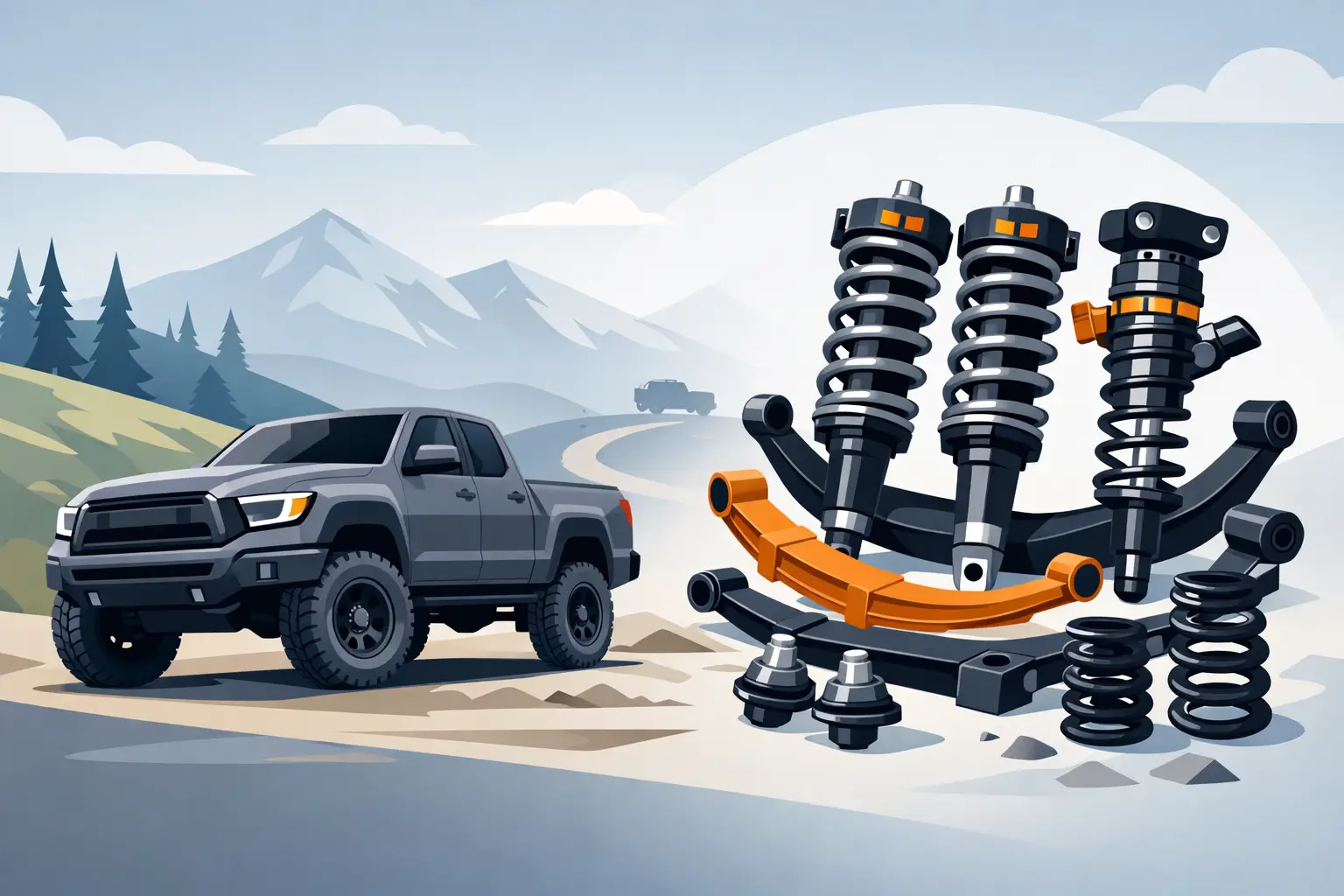
A truck that squats under a trailer, crashes over broken pavement, or feels loose in a fast on-ramp is telling you something. This truck suspension upgrade guide is built for owners who want better control, better load support, and a setup that looks right without wasting money on parts that do not match how the truck is actually used.
Suspension upgrades are not one-size-fits-all. A leveled half-ton used for city driving needs a very different setup than a work truck that tows every week, and both are different from a trail-focused build on 35s. The best results come from choosing parts around use case first, then ride height, then tire and wheel plans.
Start with the job your truck actually does
Before you buy shocks, springs, spacers, or control arms, define the truck in plain terms. Is it a daily driver with occasional home-improvement runs? A tow rig carrying tongue weight and bed cargo? A weekend off-road truck that needs more articulation and tire clearance? That answer controls almost every smart suspension decision.
If towing and hauling are the priority, rear support matters more than chasing lift numbers. If ride quality and steering precision matter most, your money usually goes farther with quality shocks and properly matched springs than with a cheap lift kit. If appearance is part of the goal, that is valid too, but stance should still work with alignment geometry, tire clearance, and braking stability. Technology as an art form only works when the form does not compromise function.
Truck suspension upgrade guide: what each part changes
A lot of suspension confusion comes from parts being sold together even though they do very different things. Knowing what each component actually does helps you avoid buying overlap.
Shocks and struts
Shocks control motion. They do not hold the truck up, but they determine how quickly the suspension compresses and settles. Upgrading worn factory shocks is often the single biggest improvement in ride control, especially on trucks with miles, oversized tires, or added weight.
For daily driving, a quality gas shock can sharpen response without making the truck harsh. For towing, look for damping that controls rebound when the rear is loaded. For off-road use, heat capacity matters because repeated impacts can overwhelm a basic shock. More expensive does not always mean better for your truck, but bargain shocks are where many builds start feeling sloppy after the first few months.
Coil springs, leaf springs, and coilovers
Springs hold the truck up and determine ride height along with load support. If the truck squats too much with cargo, that is usually a spring-rate problem, not just a shock problem. Heavier-duty rear leaf packs or helper springs can make a big difference for work use, but they can also stiffen the empty-truck ride.
Coilovers combine a spring and shock in a more adjustable package. They make sense when you want tuned ride height, better damping, and a cleaner performance-oriented solution up front. They cost more, but for many late-model trucks they provide a more refined result than stacking budget lift components.
Lift kits and leveling kits
A leveling kit usually raises the front to reduce rake. It is popular because it changes stance quickly and creates space for a larger tire. The trade-off is that not every leveling kit improves ride quality, and some reduce droop travel or push factory components beyond ideal angles.
Lift kits go further by increasing ride height front and rear. A well-engineered lift can preserve geometry far better than a cheap spacer setup, but lift always affects more than looks. Center of gravity rises, step-in height changes, fuel economy can shift, and tire, wheel, and gearing decisions start to matter more.
Control arms, bushings, and steering components
These parts are easy to ignore because they are less visible, but they matter once ride height changes. Upper control arms can restore better alignment range and ball joint angle on lifted independent front suspension trucks. Fresh bushings can remove wandering and clunks that new shocks alone will not fix. If the truck already has play in tie rods or ball joints, suspension upgrades should not happen around worn steering parts. Fix the foundation first.
Air springs and helper systems
Air helper springs are one of the smartest solutions for trucks that tow or haul inconsistently. They let you add support when loaded without committing to a permanently harsh spring rate. They are not a substitute for badly overloaded operation, but they are extremely useful for trailers, slide-in setups, and bed cargo that changes week to week.
Match the upgrade to the use case
The most effective truck suspension upgrade guide is not built around the biggest lift or the most expensive hardware. It is built around the problem you are trying to solve.
For daily driving and better street manners
Start with quality shocks or struts, inspect bushings, and replace worn components before adding height. If you want a cleaner stance, a mild level paired with properly sized tires usually delivers the visual improvement people want without forcing major geometry compromises. This is often the sweet spot for owners who want a truck that looks sharper and feels more planted every day.
For towing and hauling
Focus on rear spring support, shock control, and load stability. Helper springs, upgraded leaf packs, or air support systems often do more for a tow rig than a front-end level. If you do level the truck, think about how it will sit with trailer weight attached. A truck that looks perfect empty can become nose-high or unstable once loaded.
For off-road and larger tires
Ground clearance and wheel travel matter, but so do damping, component strength, and alignment. A quality suspension system with matched shocks, springs, and arms is worth more than stacking spacers to clear a big tire. Off-road builds also need honest attention to tire rubbing, wheel offset, and driveline angles. The cleanest build is the one that works through full travel, not just the one that photographs well parked on level ground.
Common mistakes that cost money later
The first mistake is buying for appearance only. There is nothing wrong with wanting a better stance, but once the truck rides worse, wears tires unevenly, or loses towing confidence, that cheap visual upgrade gets expensive.
The second is mixing random parts with no plan. New front spacers, old rear shocks, oversized tires, and worn control arm bushings create a truck that feels patched together. Suspension works as a system. Even basic builds benefit from choosing parts that complement each other.
The third is ignoring payload and accessory weight. A steel bumper, winch, toolbox, rack, or larger wheel and tire package changes how the truck sits and responds. Added weight should be part of the spring and shock decision from the start.
The fourth is skipping alignment and fitment checks. Every height change deserves a proper alignment. Tire clearance should be checked at full lock and compression, not just at ride height in the driveway.
How to build the right package
Start by setting a clear priority: load support, ride quality, off-road control, or stance. Then inspect the current suspension honestly. If factory parts are tired, replacing them with quality components may transform the truck before any lift is added.
Next, plan around tire size. Many suspension decisions are really tire decisions in disguise. The jump from stock-size rubber to a wider or taller tire can change clearance, steering feel, road noise, and effective gearing. Pick the tire target first, then choose the suspension that supports it properly.
After that, decide how much adjustability you actually need. Some owners benefit from adjustable coilovers or air support because their use changes often. Others are better served by a fixed, durable setup with fewer moving parts and less maintenance.
Budget should include the supporting pieces, not just the headline kit. Alignment, hardware, control arms, bump stops, and installation all count. Spending slightly more on a complete setup usually costs less than correcting a compromised build later.
When stock-style replacement is the smarter move
Not every truck needs an aggressive upgrade path. If your truck is mostly stock, used for commuting, light hauling, and occasional trips, premium replacement shocks and springs may be the right call. You keep factory-like geometry, improve control, and avoid chasing secondary issues caused by unnecessary height.
That approach is especially smart for buyers who care about long-term reliability and clean fitment. A truck can feel tighter, carry itself better, and still maintain the balanced engineering that made it useful in the first place.
What a good upgrade should feel like
The right setup should make the truck feel more settled, not more dramatic. Steering should be more predictable. Impacts should be controlled instead of bouncy. Loaded behavior should inspire confidence. And if style is part of the plan, the truck should sit with intention rather than looking like parts were added one at a time without a final picture in mind.
That is the standard worth aiming for. Choose suspension parts the same way you choose any serious truck component – by material quality, fitment, and real-world purpose. When the setup matches the job, you do not just get more height or stiffer springs. You get a truck that feels finished.