
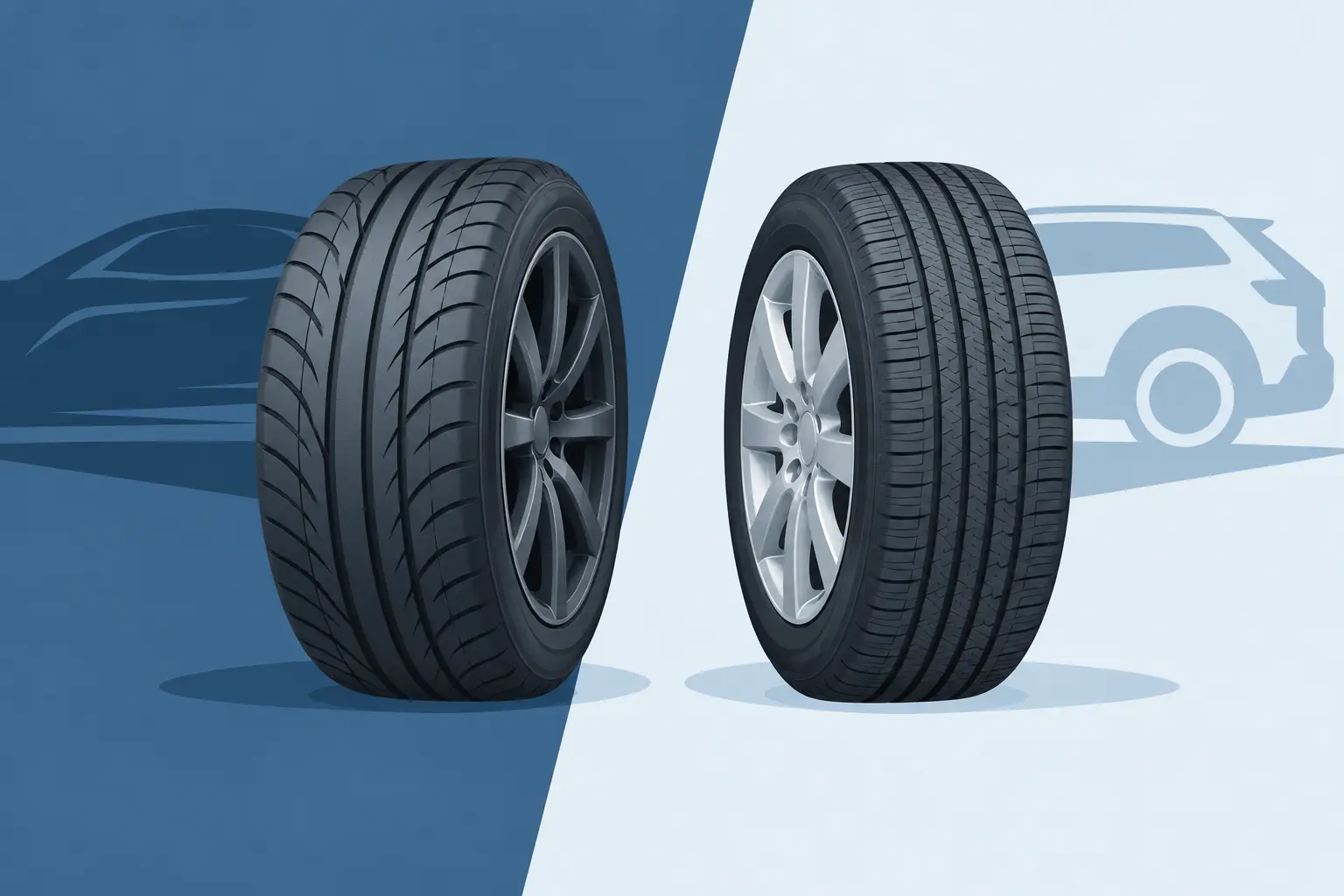
A worn set of tires is not just a maintenance item. It changes how your vehicle brakes in rain, tracks on the highway, carries a trailer, and looks at the curb. The choice between aftermarket tires versus OEM tires comes down to more than price: it is about choosing the performance priorities that match your vehicle and how you actually use it.
OEM tires reproduce the factory specification. Aftermarket tires open the door to different tread designs, load ratings, ride characteristics, and visual profiles. Neither is automatically the better purchase. The right answer depends on fitment, driving conditions, budget, and whether you want to preserve the original driving feel or refine it.
What OEM Tires Are Designed to Do
OEM means original equipment manufacturer. In this context, an OEM tire is the tire specification selected for a vehicle when it was new. The tire may be made by a major tire brand, but it was engineered and approved to meet the automaker’s targets for that specific vehicle.
Those targets usually include ride comfort, road noise, fuel economy, wet and dry handling, braking, steering response, and load capacity. For a pickup or SUV, towing stability and all-season versatility may be part of the equation. For a performance car, the factory may prioritize turn-in response and grip. On a commuter sedan, low rolling resistance and a quiet ride may carry more weight.
Replacing your tires with the same OEM model or the exact OEM specification is the lowest-risk way to preserve the vehicle’s original character. This is especially useful when you liked the way the vehicle drove when new and do not need a different capability.
There are trade-offs. A factory tire is often chosen as a compromise that works for the widest range of owners, climates, and driving habits. It may not be the strongest choice for heavy hauling, deep snow, trail use, spirited driving, or a more aggressive wheel-and-tire stance. Exact OEM replacements can also be more expensive or harder to find once a vehicle has been on the road for several years.
Aftermarket Tires Versus OEM Tires: The Real Differences
Aftermarket tires are replacement tires sold outside the vehicle manufacturer’s original supply program. That does not mean they are generic or lower quality. It means the buyer has more choices than the factory-installed tire. Reputable aftermarket options range from value-focused touring tires to purpose-built all-terrain, winter, mud-terrain, and ultra-high-performance designs.
The biggest advantage is control. An aftermarket tire can be selected around a clear need rather than a broad factory compromise. A Jeep owner may want stronger sidewalls and a more open tread pattern for unpaved routes. A truck owner who tows may need a higher load range and stable highway manners. An SUV owner may prefer a quieter touring tire with confident wet-weather braking. The tire category should follow the job, not the badge on the tailgate.
Ride quality can change noticeably. Some all-terrain tires add road noise and weight in exchange for traction and durability. A performance-oriented tire may sharpen steering feel while wearing faster than an all-season touring tire. A low-rolling-resistance replacement may support fuel economy but feel different at the limit. These are not defects. They are design decisions, and the best decision is the one that fits your priorities.
Price is also more flexible in the aftermarket. There are options at multiple price points, but the cheapest tire is not always the least expensive choice over time. Tread life, wet traction, casing durability, and warranty coverage affect total ownership cost. A tire that wears evenly and performs predictably can be a better value than one with a low initial price and short service life.
Start With Fitment, Not Tread Style
Fitment is where a smart tire purchase begins. The tire size printed on your sidewall includes width, aspect ratio, construction type, wheel diameter, load index, and speed rating. For example, 265/70R17 is not interchangeable with every 17-inch tire. Its overall diameter, width, and load capacity affect clearance, speedometer accuracy, gearing, and handling.
Staying with the factory size is the simplest approach. If you plan to change size, confirm clearance at full steering lock and through suspension travel. Check whether the tire will contact fenders, liners, control arms, or suspension components. On trucks, Jeeps, and lifted SUVs, a larger tire can improve ground clearance and appearance, but it can also add weight, reduce acceleration, affect braking feel, and require wheel-offset or suspension changes.
Load index and speed rating deserve the same attention as size. Never select a replacement tire with less load capacity than your vehicle requires. This matters even more for loaded SUVs, work trucks, and towing applications. A higher speed rating can offer a different handling profile, but it does not override safe driving practices or vehicle limits.
If you are replacing only one or two tires, match the remaining tires as closely as possible in size, type, and tread depth. On many all-wheel-drive vehicles, significant tread-depth differences can place extra stress on drivetrain components. Follow the vehicle manufacturer’s guidance for replacement practices.
Match the Tire to the Miles You Drive
Think about your normal driving week before choosing a tire category. A vehicle that spends 95 percent of its time on paved roads usually benefits from a quality touring or highway all-season tire, even if it occasionally sees a gravel road. A truck that regularly pulls equipment needs a tire selected for its actual load and duty cycle, not just an aggressive appearance.
For snow and sustained cold, a dedicated winter tire remains the strongest traction-focused choice. Many all-weather and all-terrain tires offer useful winter capability, but they are not automatically equal to a purpose-built winter tire on ice and packed snow. For hot-weather performance driving, summer tires can deliver exceptional grip, but they lose effectiveness in cold temperatures and are not designed for snow.
This is where aftermarket selection earns its value. You can choose a tire that reflects your climate, terrain, payload, and driving style instead of accepting a one-size factory balance.
Warranty, Installation, and Long-Term Performance
OEM and aftermarket tires can both carry warranties, but warranty terms vary by manufacturer and model. Review treadwear coverage, workmanship coverage, road-hazard options, and any conditions related to rotation, alignment, or inflation records. A mileage warranty is useful only when the tire is installed, maintained, and used within its intended category.
Professional mounting and balancing matter. So do correct tire pressure, regular rotation, alignment checks, and suspension maintenance. A premium tire cannot compensate for worn shocks, damaged steering components, or an alignment that scrubs the tread from one edge. If the old tires wore unevenly, find the cause before installing a new set.
For vehicles with tire-pressure monitoring systems, make sure the sensors are inspected and serviced during installation. After changing tire size, confirm that the inflation pressure remains appropriate for the tire and vehicle application. The number molded on the tire sidewall is the maximum inflation pressure, not necessarily the correct operating pressure.
When OEM Makes Sense and When Aftermarket Wins
Choose an OEM-equivalent tire when preserving factory ride, noise levels, and predictable behavior is your main goal. It is a practical choice for leased vehicles, low-mileage daily drivers, and owners who are satisfied with the original tire’s performance.
Choose an aftermarket tire when you have a specific improvement in mind: more wet-weather confidence, longer tread life, better snow traction, a higher load rating, stronger off-road capability, or a different look around your wheels. For enthusiast builds, tire selection is part of the vehicle’s design language. The right sidewall profile and tread pattern can complement the stance, wheel finish, and functional character of the build without sacrificing fitment discipline.
FORTLUFT customers often shop across maintenance and upgrade categories because the best builds do both. A tire should support how the vehicle works, but it can also reinforce how the vehicle looks. Technology as an art form starts with parts that perform their role without compromise.
Before ordering, confirm the vehicle year, make, model, trim, wheel diameter, and intended use. Then choose the tire that serves the next mile, whether that mile is a daily commute, a loaded work run, a wet interstate, or the trailhead.