
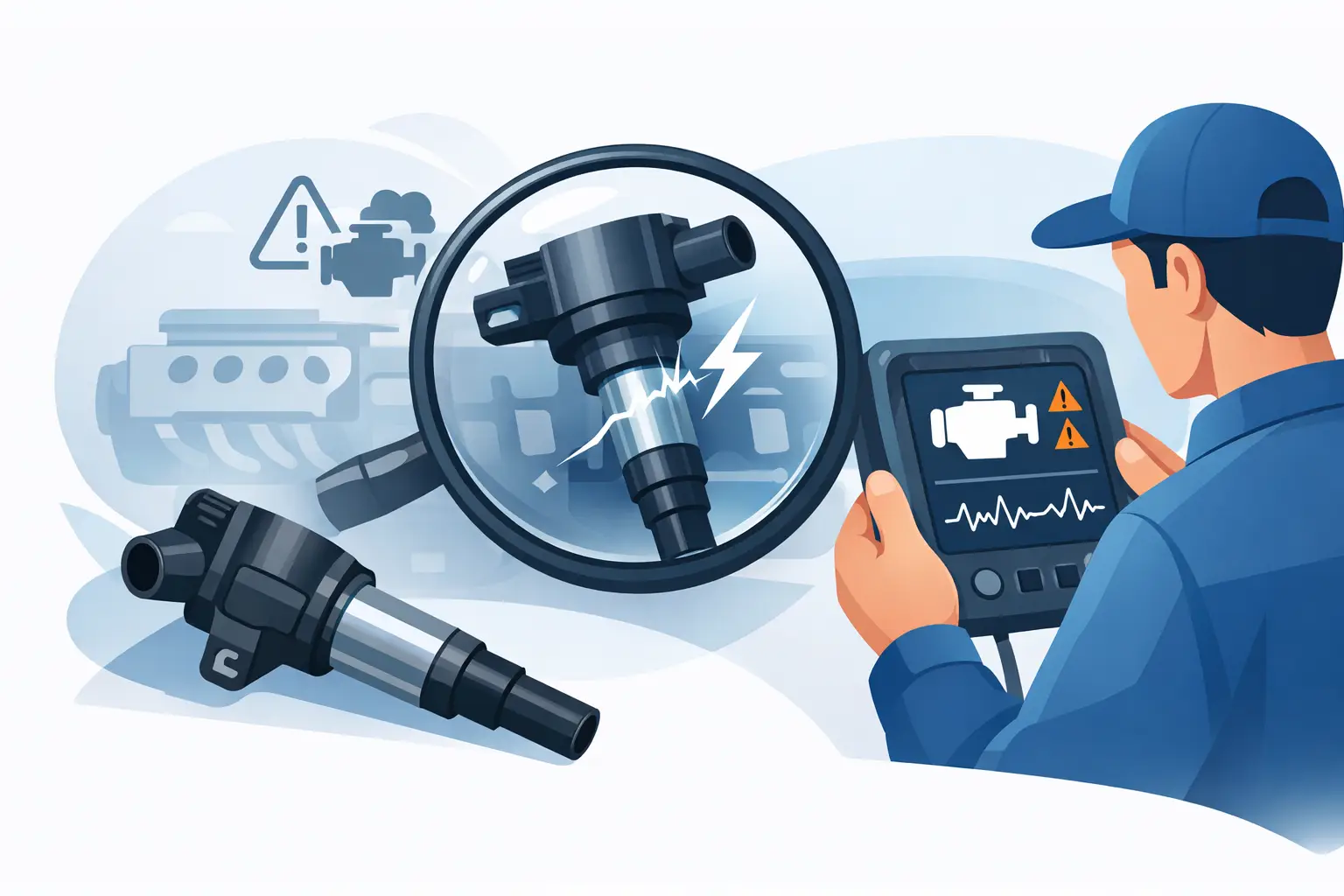
A rough idle that shows up out of nowhere, a flashing check engine light under load, or a crank-no-start that feels random – those are the moments when knowing how to diagnose ignition coil faults saves time, money, and a lot of guesswork. The coil sits at the center of spark delivery, and when it gets weak or fails outright, the engine usually tells you fast.
What an ignition coil actually does
Your battery only delivers low voltage. The ignition coil transforms that into the high voltage needed to fire the spark plugs. On older vehicles, one coil might feed multiple cylinders through plug wires. On many modern cars, trucks, Jeeps, and SUVs, each cylinder has its own coil-on-plug unit.
That design affects diagnosis. A single bad coil on a coil-on-plug setup may cause one-cylinder misfire symptoms. On a distributor or coil-pack system, one failing unit can affect multiple cylinders at once. Same basic part, different failure pattern.
Common signs before you diagnose ignition coil failure
An ignition coil rarely fails in a dramatic, cinematic way. More often, performance drops first. The engine may stumble under acceleration, idle unevenly, or hesitate during cold starts. Fuel economy can dip because the air-fuel mixture is no longer burning consistently.
You may also notice a check engine light with misfire-related trouble codes. Codes like P0300 for random misfire or P0301 through P0308 for cylinder-specific misfires are common clues. If the vehicle shakes at idle and smooths out slightly at higher rpm, that can point to a weak coil, but it can also be spark plugs, injectors, vacuum leaks, or compression issues. That is where real diagnosis matters.
Symptoms that often get mistaken for a bad coil
Spark plugs with excessive wear, oil in the plug wells, damaged connectors, low battery voltage, and even a failing fuel injector can mimic coil problems. A bad coil can also damage a plug, and a bad plug can overload a coil. If you replace one without checking the other, the fix may not last.
How to diagnose ignition coil step by step
The fastest way to diagnose an ignition coil is to combine scan data, visual inspection, and a targeted test rather than replacing parts based on symptoms alone.
Start with codes and freeze-frame data
Use a scan tool before touching anything. Look for active and stored codes, then note which cylinder is involved if the code is cylinder-specific. Freeze-frame data helps you see when the fault happened – cold start, idle, hard acceleration, or highway cruise. That context matters because some coils fail only when hot or only under load.
If you have a P0304, for example, cylinder 4 becomes your starting point, not your conclusion. The code tells you where the misfire is detected, not always what caused it.
Inspect the coil and surrounding parts
Remove the engine cover if needed and inspect the suspect coil. Look for cracks in the housing, carbon tracking, melted plastic, corrosion in the connector, or oil and moisture in the spark plug tube. On coil-on-plug systems, valve cover gasket leaks are a frequent hidden cause of ignition trouble because oil contamination can affect both the boot and the plug.
Check the harness too. A loose connector or damaged wire can interrupt the coil trigger signal and look exactly like a failed coil.
Check the spark plug before blaming the coil
Pull the spark plug from the affected cylinder. If the plug is heavily worn, fouled, oil-soaked, or has an incorrect gap, the coil may not be the root problem. Installing a fresh coil on a worn-out plug is like asking one new component to compensate for a failing one beside it. It can work for a moment, but it is not a clean repair.
This is one of the biggest trade-offs in ignition diagnosis. If mileage is high and plugs are overdue, replacing only the coil may get the engine running better, but not necessarily right.
Swap-test the coil when the system allows it
On coil-on-plug engines, the simplest field test is often a coil swap. Move the suspected coil to another cylinder, clear the codes, and run the engine again. If the misfire code follows the coil from cylinder 4 to cylinder 2, for example, you have strong evidence the coil is bad.
If the misfire stays on the original cylinder, the problem is more likely the spark plug, injector, compression, or wiring. This test is quick, practical, and hard to beat on modern engines.
It does have limits. Some intermittent coils fail only when fully heat-soaked, and some vehicles make coil access time-consuming. But when access is reasonable, this is one of the most efficient ways to diagnose.
Test for spark if the engine will not start
If the engine cranks but does not start, check whether the coil is producing spark. Use a proper spark tester rather than improvising with a loose plug against metal. A bright, consistent spark suggests the coil is at least functioning. Weak or absent spark points you toward the ignition circuit.
If there is no spark, do not stop at the coil itself. Verify power supply to the coil and confirm the control signal from the PCM. A coil cannot fire if it is not being commanded.
Use a multimeter carefully
Some service information includes primary and secondary resistance specs for ignition coils. If specs are available for your exact application, a multimeter can help identify an open or shorted coil winding. Measure resistance only according to the manufacturer procedure.
That said, resistance testing has limits on many modern coils. A coil can pass a basic ohms test and still fail under heat and load. This is why real-world symptom testing and swap testing are often more useful than bench-style resistance checks alone.
Consider heat-related failure
A vehicle that runs well cold and misfires after 20 minutes may have a coil breaking down internally as temperature rises. In those cases, diagnosis may require running the engine until the symptom appears, then testing immediately. Intermittent faults are frustrating because they reward patience more than speed.
When the problem is not the coil
If you have confirmed power and command at the connector, the spark plug is good, and the misfire does not follow the coil during a swap, expand the search. Fuel injector pulse, intake leaks near that cylinder, and compression loss all belong on the table.
A burned valve, for example, can trigger the same cylinder-specific misfire code as a bad coil. So can a leaking intake gasket on certain engines. Good diagnosis is not about forcing every symptom into one category. It is about eliminating the wrong categories quickly.
Should you replace one coil or all of them?
It depends on mileage, failure pattern, and budget. If one coil has clearly failed and the others are not showing signs of age or heat damage, replacing just the bad unit is reasonable. If the vehicle has high mileage and the coils are original, replacing multiple coils may reduce the chance of repeat repairs.
There is no universal rule here. For a daily driver where uptime matters, a broader refresh can make sense. For a lower-mileage vehicle with one isolated failure, targeted replacement is often the smarter move.
Parts quality matters more than it seems
Ignition parts are not a good place to gamble on questionable quality. A poorly made coil may work out of the box and still create a comeback issue weeks later. Fitment, connector quality, insulation, and heat resistance all matter, especially in modern engine bays where temperatures run high.
That is why buyers who care about reliable repair results tend to shop with the same discipline they use for performance upgrades. Whether the goal is clean drivability or dependable work-truck service, the right ignition components should perform with precision, not just fit the hole. That mindset is part of what makes aftermarket maintenance more than basic replacement – technology as an art form, done right.
A practical call on DIY vs. shop diagnosis
If your vehicle has easy coil access, a scan tool, and a clear cylinder-specific misfire, this is a realistic DIY job. If the intake manifold has to come off, the misfire is intermittent, or wiring diagnostics are involved, professional testing may save money in the long run.
The smart move is not always the cheapest move up front. It is the one that gets you to the actual fault without stacking unnecessary parts.
How to avoid repeat ignition coil failure
Once you fix the issue, look at the conditions that may have caused it. Replace worn plugs on schedule. Repair oil leaks into plug wells. Make sure connectors lock securely and battery voltage stays healthy. A new coil installed next to an old problem usually becomes an old problem too.
If you are sorting out a rough-running engine, stay methodical. The best answer to how to diagnose ignition coil trouble is not a shortcut – it is a clean process that tells you whether the coil is truly the weak link or just the first part that got blamed.