
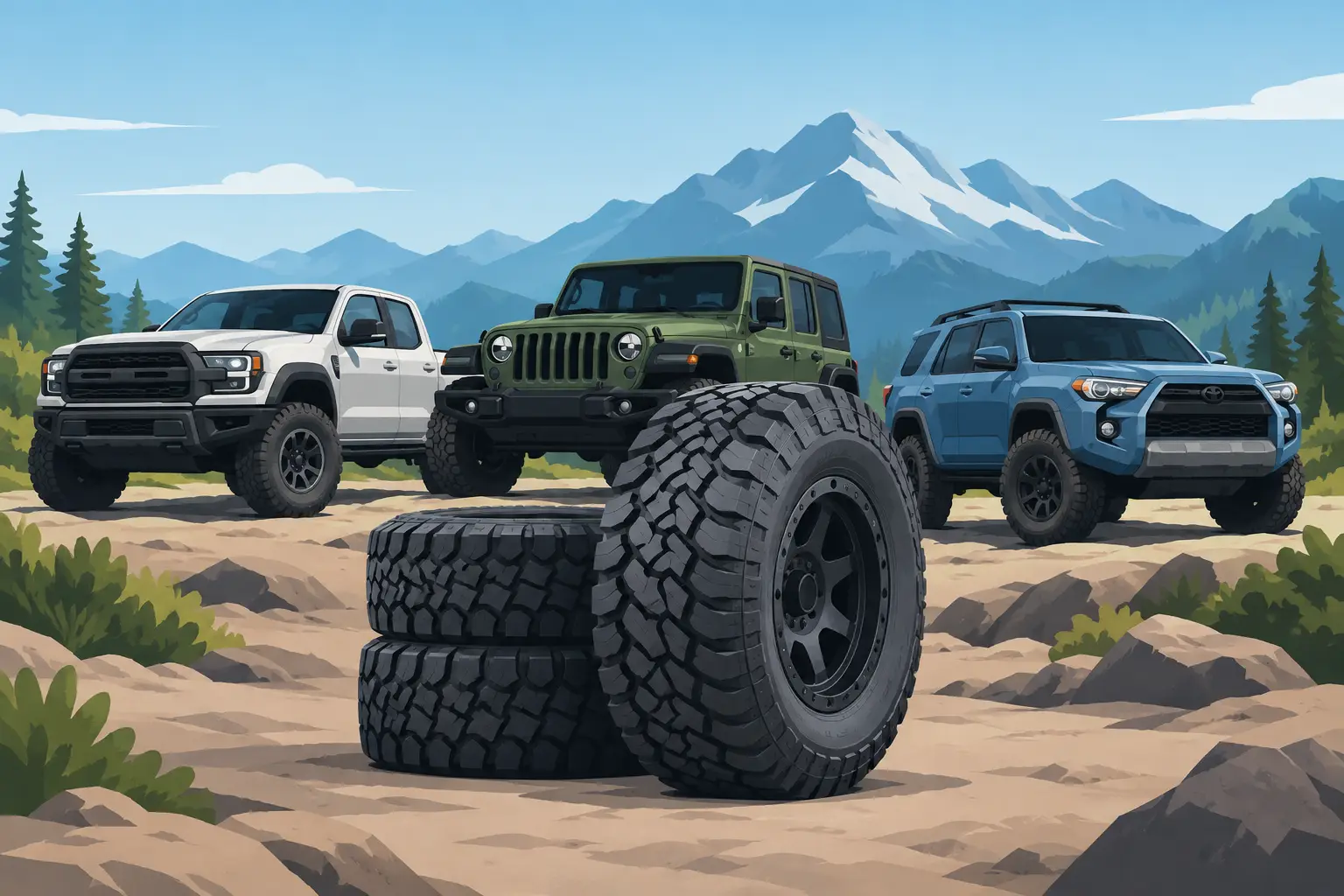
The right tire changes more than how a truck, Jeep, or SUV looks in the driveway. It determines whether you climb out of a rutted trail, stop predictably in rain, carry a loaded work trailer safely, or spend every highway mile listening to tread roar. This offroad tire review focuses on the specifications that matter before you buy, not just the most aggressive tread in the product photo.
Start With Where the Vehicle Actually Drives
Most offroad tire decisions go wrong when a vehicle is built for a weekend of mud but driven 95 percent of the time on pavement. Aggressive tires have a purpose, but that purpose comes with compromises in road noise, wet-road behavior, tread life, fuel economy, and steering precision.
Be realistic about the surface that takes up most of your miles. A daily-driven SUV that sees forest roads, gravel, snow, and occasional camping trails usually needs a different tire than a dedicated trail Jeep. Likewise, a work truck that travels construction access roads needs dependable casing strength and load capacity, not necessarily the widest mud lugs available.
Your vehicle’s weight, power, suspension height, wheel width, gearing, and available fender clearance are part of the equation. A larger tire may create the stance you want, but a poor fit can cause rubbing at full steering lock or suspension compression. It can also affect acceleration, braking feel, speedometer accuracy, and transmission shift behavior.
Offroad Tire Review: Understand the Tread Categories
Tread category is the fastest way to narrow the field. There is no universal best tire because all-terrain, mud-terrain, and rugged-terrain designs solve different problems.
All-terrain tires
All-terrain tires are the practical choice for many trucks, Jeeps, and SUVs. Their tread blocks, channels, and shoulder design provide substantially more loose-surface traction than a highway tire while preserving civilized pavement manners. They are often available in a broad range of factory-friendly sizes and load ratings.
For overlanding, light trail use, gravel roads, wet grass, and changing weather, a quality all-terrain tire is difficult to beat. Look for open shoulder channels to release gravel and mud, sipes for wet and snowy traction, and a tread pattern that does not become overly smooth after a few thousand highway miles.
The trade-off is simple: an all-terrain will not clear deep mud or bite loose rock as aggressively as a true mud-terrain. Still, for a vehicle that earns daily miles between trail days, it is usually the better long-term choice.
Mud-terrain tires
Mud-terrain tires use larger, more widely spaced tread blocks. The voids between those blocks help the tire shed mud rather than packing solid, while reinforced shoulders can add useful grip when the vehicle is leaned into ruts or rocks.
This is the right category for frequent mud, deep ruts, loose climbs, and dedicated off-road builds. Sidewall lugs can provide extra traction at lower pressures, although they should not be mistaken for a guarantee against punctures.
On the street, mud-terrain tires ask more of the driver. They tend to be louder, may wear less evenly if rotations are skipped, and can feel less composed in heavy rain than a good all-terrain. Modern designs have improved considerably, but the basic compromise remains. Buy a mud-terrain for the terrain you regularly face, not for the image alone.
Rugged-terrain and hybrid tires
Rugged-terrain or hybrid tires sit between the two categories. They use a more open, aggressive tread than an all-terrain, often with pronounced sidewall features, but retain tighter center blocks than a mud-terrain for better pavement control.
They make sense for drivers who spend serious time off pavement but still commute, tow, or take long highway trips. The exact balance varies widely by tire design, so study the tread layout and ratings instead of assuming every hybrid tire behaves the same way.
Read the Sidewall Before Comparing Appearance
Tire size is more than a diameter number. A size such as LT285/70R17 identifies the tire’s construction, width, aspect ratio, radial construction, and wheel diameter. It does not tell the complete story about its intended use or how it will carry weight.
LT, or Light Truck, tires are commonly built with stronger casings and higher load capacities than P-metric passenger tires. That can be valuable for full-size trucks, loaded SUVs, towing, rocky trails, and vehicles carrying recovery gear or camping equipment. The penalty can be additional weight and a firmer ride.
A P-metric all-terrain can be a sensible option for a lighter SUV or crossover that spends most of its life on the road. Do not automatically choose LT construction simply because it sounds tougher. Match the tire to vehicle weight, axle load, and how the vehicle is used.
Pay close attention to load index, load range, and maximum inflation pressure. These ratings must meet or exceed the vehicle manufacturer’s requirements. Higher load range does not automatically mean better performance. An overly stiff tire can ride harshly and may be difficult to tune for comfortable everyday driving.
The three-peak mountain snowflake marking deserves attention for drivers who encounter true winter conditions. It indicates that the tire meets a standardized snow-traction threshold. A tire labeled M+S may offer useful all-season capability, but it is not the same standard. Neither marking replaces a dedicated winter tire where severe ice and consistently deep snow are the norm.
Sidewalls Matter When the Trail Gets Sharp
The tread gets most of the attention, but sidewall damage ends plenty of off-road days. Multi-ply sidewall construction, cut-resistant compounds, and reinforced shoulder zones can offer meaningful protection when trails include sharp rock, broken shale, stumps, and debris.
More protection usually means more weight. Heavier tires affect unsprung mass, braking, acceleration, steering response, and fuel use. That does not make reinforced tires a bad choice. It means a lightly used trail rig and a heavily loaded expedition truck should not necessarily wear the same construction.
Wheel size also affects sidewall height. A 17-inch wheel with a taller sidewall is often more trail-friendly than a larger wheel paired with a thin tire. More sidewall can improve ride compliance and provide greater flexibility when airing down, provided the wheel, tire, and pressure are appropriate for the application.
Wet Pavement, Noise, and Wear Are Real Performance Tests
An offroad tire is still a road tire for most owners. Look for channels that evacuate water, ample siping for wet grip, and a tread compound designed to remain predictable across temperature changes. A tire that looks capable but loses confidence in standing water is not a strong all-around choice.
Noise is subjective, but tread shape tells a useful story. Large, evenly spaced lugs usually create more highway hum. Variable pitch patterns can help reduce it, while a tighter center tread typically improves on-road quietness. If the vehicle handles family travel, client visits, or long interstate drives, noise deserves a place in the buying decision.
Treadwear depends on alignment, inflation, driving style, rotation schedule, and vehicle load as much as tire design. Rotate at the interval recommended by the tire and vehicle manufacturer, and inspect the tread for feathering, cupping, or uneven shoulder wear. Those patterns often point to an alignment, suspension, balance, or pressure issue that a new set of tires will not fix.
Choose Size for Clearance and Capability
A larger tire can improve ground clearance under the differential and help a vehicle roll over obstacles more easily. It can also require suspension modifications, trimming, offset changes, or recalibration. Do not rely on a nominal size alone because actual measured diameter and section width vary by manufacturer and wheel width.
Before stepping up in size, check clearance at full lock and full suspension travel, not just while parked. Consider spare-tire fitment, too. A full-size spare should match the rolling diameter of the tires on the ground, especially on four-wheel-drive and all-wheel-drive vehicles.
For many owners, staying close to the factory diameter or making a modest increase delivers the best combination of fitment, gearing, braking, and available tire choices. Capability is more useful when it remains predictable.
Build the Tire Package Around the Job
A tire should work with the rest of the vehicle. Suspension, wheels, alignment settings, load distribution, and driving habits all influence its performance. FORTLUFT customers who pair functional upgrades with a clean, intentional look should treat tire selection the same way: choose materials, fitment, and design that serve the vehicle rather than overpower it.
If you tow, calculate the real loaded weight. If you wheel rocky trails, prioritize sidewall protection and a usable pressure strategy. If snow and rain shape your winter commute, give wet traction and winter certification more weight than extreme shoulder lugs. The best tire is not the most aggressive option. It is the one that gives your vehicle confident traction exactly where you ask it to work.