
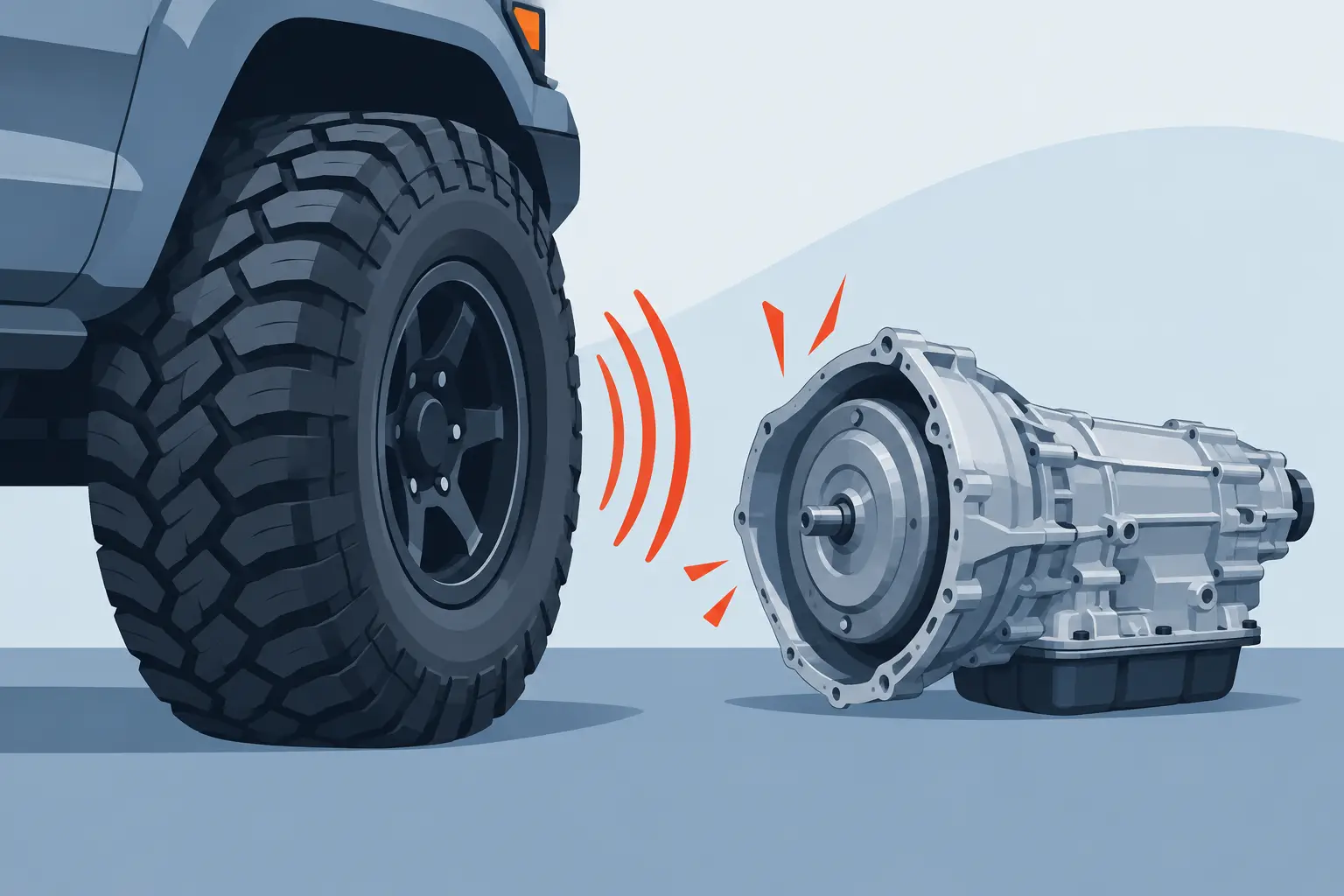
A larger tire can transform the stance, ground clearance, and capability of a truck, Jeep, or SUV. But can oversized tires damage transmission components? They can contribute to transmission wear when the tire upgrade is too large for the vehicle’s gearing, powertrain calibration, and intended use. The tire itself is not the problem. The added load it creates is.
How oversized tires affect the transmission
Tire diameter changes the mechanical leverage between the engine and the road. A taller tire travels farther in one rotation, so the engine and transmission must work harder to deliver the same force at the contact patch. This effect is similar to installing numerically lower axle gears.
For example, moving from a 31-inch tire to a 35-inch tire does more than fill the wheel well. It effectively raises the final drive ratio. Acceleration becomes softer, hills require more throttle, and the transmission may hold lower gears longer or downshift more often. On an automatic transmission, that additional shifting and torque-converter activity can raise operating temperature.
Heat is the main concern. Transmission fluid carries heat away from clutches, gears, valve body components, and the torque converter. When a vehicle repeatedly pulls a heavier tire and wheel assembly, especially in traffic, towing, sand, mud, or mountain driving, fluid temperatures can climb beyond the range the original cooling system was designed to handle.
That does not mean every lifted vehicle with bigger tires is headed for transmission failure. A mild tire increase on a lightly used vehicle may create no noticeable issue. The risk rises when tire size, tire weight, wheel offset, vehicle load, and driving conditions all move in the same direction.
Why tire weight matters as much as tire diameter
Diameter gets most of the attention, but weight often has a more immediate effect on how a vehicle feels. Large all-terrain and mud-terrain tires typically weigh more than factory tires. Add a heavier wheel, beadlock-style design, or wide offset, and the drivetrain is now accelerating considerably more rotating mass.
Rotating mass takes more energy to start, stop, and change direction than comparable weight carried inside the cabin. That extra demand reaches the engine, transmission, transfer case, driveshafts, axle shafts, brakes, and wheel bearings.
A 33-inch tire built for daily-road use may be relatively manageable. A 37-inch mud-terrain tire on a heavy steel wheel is a different system entirely. Two tires with the same diameter can produce very different drivetrain loads based on construction, tread depth, wheel weight, inflation pressure, and intended terrain.
Automatic transmissions face a specific challenge
Automatic transmissions are sensitive to heat and shift behavior. With oversized tires, the transmission may hunt between gears because the vehicle falls below or rises above its programmed shift points more often. It may also spend more time with the torque converter unlocked, which creates heat.
Modern electronically controlled transmissions can adapt within a limited range, but calibration does not erase the added mechanical load. If the speedometer and tire-size settings are not corrected, the transmission control module may also receive inaccurate vehicle-speed information. That can affect shift timing, odometer accuracy, cruise control behavior, and driver-assistance features on some vehicles.
Manual transmissions and transfer cases are not exempt
A manual transmission avoids automatic shift hunting, but it still sees higher load. Drivers may need to downshift sooner, use more clutch slip when starting, and work the engine harder at low speed. Repeated clutch slip can shorten clutch life.
Four-wheel-drive vehicles add another layer. Oversized tires place more torque demand on the transfer case and axles, particularly in low-traction conditions where traction suddenly returns. Hard launches, rock crawling, and deep mud can turn a manageable tire upgrade into a serious drivetrain stress test.
Signs your tire setup is working the transmission too hard
The first signs are often subtle. A vehicle may feel slower leaving a stop, struggle to maintain speed on grades, or downshift more aggressively than it did on stock tires. Drivers may notice higher transmission temperatures, delayed shifts, flares between gears, or a burnt odor from overheated fluid.
Do not assume every new shift characteristic is normal after a tire upgrade. If the transmission begins slipping, shuddering, banging into gear, or displaying a warning light, stop treating the issue as a cosmetic side effect. Diagnose it promptly.
Pay attention to these conditions, especially when they happen together:
- Frequent gear hunting at highway speed or on moderate grades
- Transmission temperatures that rise sharply while towing or off-roading
- Reduced acceleration paired with unusually high engine RPM
- Harsh, delayed, or inconsistent shifts after the tire change
- Darkened transmission fluid or a burnt-fluid smell
These symptoms can also come from existing transmission problems, incorrect fluid level, poor tuning, or sensor faults. Bigger tires may expose a weakness that was already developing rather than cause it alone.
How much bigger is too big?
There is no universal cutoff because vehicles leave the factory with different engines, transmissions, axle ratios, cooling capacity, and vehicle weights. A two-inch increase in tire diameter may be modest on one truck and substantial on another.
As a practical rule, a small increase often works well when the vehicle is not regularly towing or hauling. Once tire diameter increases by roughly 10 percent or more, it is worth treating the build as a drivetrain project, not simply a wheel-and-tire purchase. That means verifying fitment, recalibrating vehicle systems, and considering gear ratio changes.
Towing shifts the calculation quickly. A truck that handles larger tires for daily driving may struggle with a loaded trailer because engine torque must overcome tire leverage, vehicle weight, trailer weight, wind resistance, and grades. For work vehicles, transmission temperature monitoring and proper axle gearing are practical protection, not optional accessories.
Build a safer oversized-tire setup
The best builds balance appearance, capability, and mechanical sympathy. Start with actual tire diameter and weight, rather than the sidewall size alone. Published tire dimensions can vary by brand and model, and a tire’s real mounted height depends on wheel width and inflation pressure.
Correct the speedometer and tire-size programming after installation. Accurate speed data helps the driver, but it also supports proper transmission behavior on many late-model vehicles. Some applications may benefit from revised shift calibration, though programming should be matched to the specific vehicle and used responsibly.
For more substantial tire increases, consider axle re-gearing. A numerically higher axle ratio restores leverage lost to taller tires, bringing acceleration, shift behavior, and towing performance closer to the factory feel. Re-gearing is a larger investment, but it can reduce unnecessary transmission strain over the long term.
Transmission cooling deserves equal attention. If the vehicle sees hot weather, towing, trail work, or long highway grades, a quality auxiliary transmission cooler can help keep fluid temperatures under control. Use the manufacturer-specified fluid, follow appropriate service intervals, and inspect for leaks after any drivetrain work.
Wheel selection matters, too. Choosing a wheel with sensible weight and correct offset can reduce unnecessary stress while preserving the look you want. Excessive offset may increase leverage on wheel bearings and suspension components, while an overly heavy wheel can make every acceleration and braking event more demanding.
Fitment is more than clearing the fenders
A tire that clears at rest may still rub during turns, suspension compression, or articulation. Rubbing can damage tires, liners, wiring, brake hoses, and suspension components. A proper fitment check should account for full steering lock, bump travel, wheel offset, and load.
Suspension changes can create their own drivetrain angles and alignment considerations. Lifting a vehicle without addressing driveline geometry may introduce vibration or premature wear that gets blamed on the tires. The cleanest builds treat tires, wheels, suspension, gearing, and calibration as connected choices.
At FORTLUFT, the goal is the same whether you are refreshing a daily driver or building a more capable SUV: select components that work together and look intentional. Technology as an art form only works when the engineering is right underneath.
Oversized tires can be a smart upgrade, not a gamble. Match tire size to how the vehicle is driven, keep an eye on transmission temperature and shift behavior, and make the supporting upgrades before the drivetrain asks for them.