
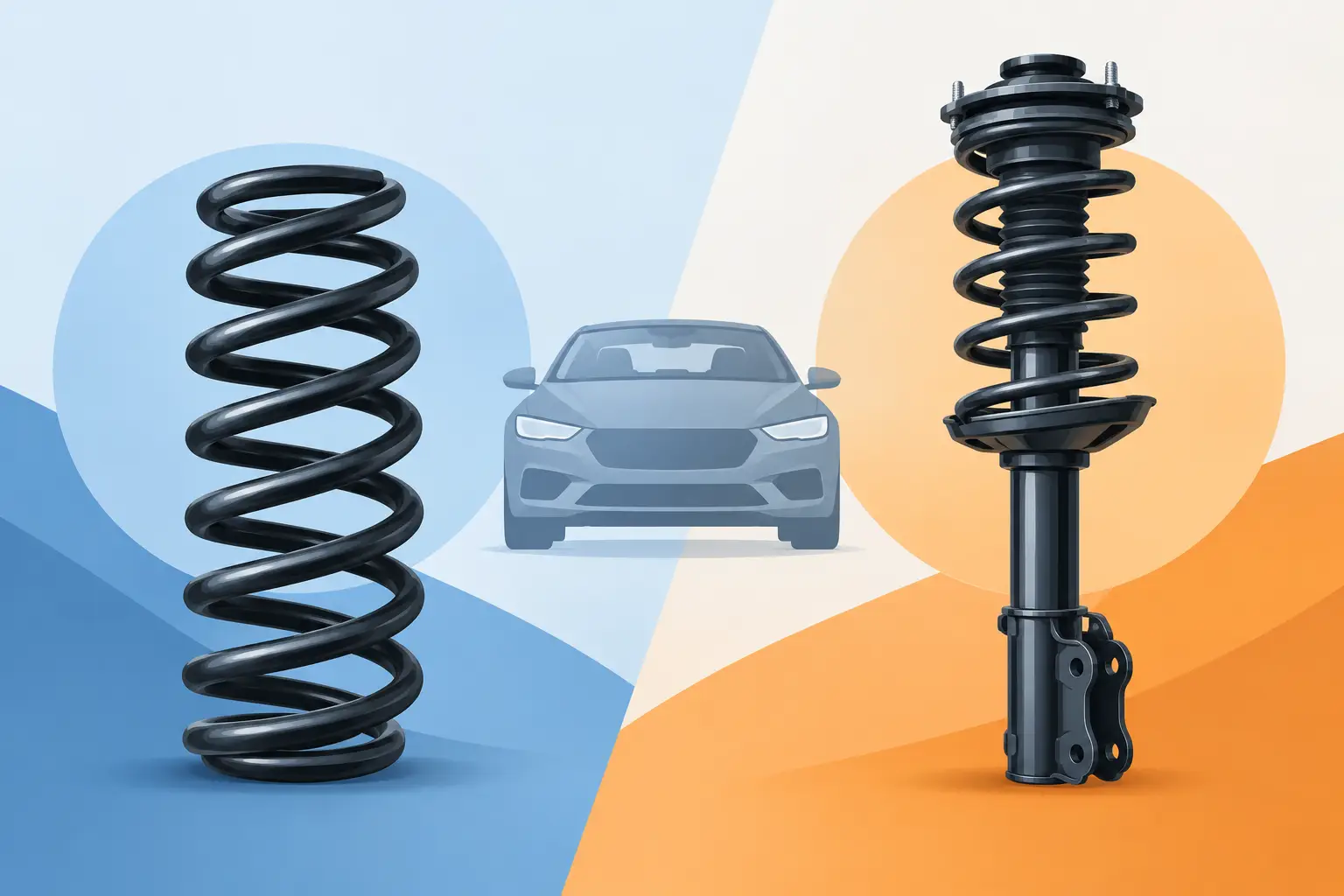
A vehicle that bottoms out over driveway entrances, leans hard in corners, or clunks over rough pavement is telling you something about its suspension. But when the repair estimate says “springs and struts,” the distinction can get blurry. Coil springs vs struts is not a straight one-or-the-other comparison: a coil spring supports the vehicle’s weight, while a strut is a structural suspension assembly that controls wheel movement and damping. On many vehicles, they work as one unit.
Knowing the difference helps you order the right replacement parts, recognize a realistic repair recommendation, and choose upgrades that match how you use your car, truck, Jeep, or SUV.
Coil Springs vs Struts: The Core Difference
A coil spring is a tightly wound steel spring positioned between the vehicle body and a suspension mounting point. Its primary job is simple but essential: carry the vehicle’s weight at the correct ride height while compressing and rebounding over road imperfections. Without springs, every bump would transfer directly into the chassis.
A strut is more than a shock absorber. It is a load-bearing suspension member that commonly combines a damper, spring seat, mounting hardware, and steering-related structural support in one assembly. On front-wheel-drive cars and many crossovers, the strut often connects near the wheel hub and extends to a mount at the top of the body. This layout is commonly called a MacPherson strut suspension.
The damper inside a strut controls the spring’s motion. A spring that is allowed to bounce freely would keep oscillating after every bump. The strut slows that movement, helping the tire stay planted and giving the vehicle predictable steering, braking, and handling behavior.
That means a worn strut and a sagging coil spring create different problems, even when the symptoms overlap. One controls motion; the other establishes support and ride height.
What Coil Springs Do for Ride Height and Load Support
Coil springs are selected for a specific spring rate, which is the amount of force needed to compress the spring a given distance. A softer spring rate can improve comfort on uneven pavement, while a stiffer rate reduces body roll and limits squat, dive, and bottoming out. Neither is automatically better. The right rate depends on vehicle weight, suspension design, tire size, cargo demands, and intended use.
On a daily driver, original-equipment-style replacement springs are usually the smart move when a spring is broken, corroded, or visibly sagging. They restore factory ride height and preserve the suspension geometry the vehicle was designed around.
For trucks, Jeeps, and SUVs that regularly carry tools, tow trailers, or travel with a full cargo area, upgraded or load-rated springs may better maintain ride height under weight. They can reduce rear-end sag and improve control, but they may also make an unloaded vehicle feel firmer. A spring built for heavy cargo is not necessarily ideal for a lightly used commuter.
Lowering springs are another category. They can give a car a more planted stance and reduce body roll by lowering the center of gravity. The trade-off is reduced suspension travel. If the drop is too aggressive or the matching dampers are not designed for it, ride quality can suffer and bottoming out becomes more likely.
What Struts Do for Control, Braking, and Steering
Struts manage the energy created when a wheel encounters a bump, pothole, or expansion joint. Good struts help the tire return to the road quickly instead of skipping or bouncing. This matters well beyond comfort. Tire contact affects braking distance, wet-road confidence, steering response, and stability during quick lane changes.
Because a strut is a structural member, its condition can also influence alignment and steering feel. A bent strut, worn upper mount, damaged spring seat, or degraded bearing can create noise, steering resistance, uneven tire wear, or a pull that does not disappear with a basic alignment.
Struts usually wear gradually, which makes the change easy to miss. Drivers often adapt to increased body motion until a new set of struts makes the difference obvious. Common signs include repeated bouncing after a bump, noticeable nose dive under braking, excessive body roll, cupped tire wear, fluid leakage, and knocking over rough roads.
A leaking strut should not be ignored, but a dry exterior does not guarantee that the internal valving is still working properly. Mileage, handling changes, and tire wear all belong in the diagnosis.
Why Springs and Struts Are Often Replaced Together
A coil spring may be mounted directly around a strut, creating a coilover-style strut assembly. In this setup, replacing the strut can require compressing and transferring the spring. That process requires the right spring compressor and careful technique. A compressed coil spring stores significant energy, so this is not a place to improvise with unsuitable tools.
Complete strut assemblies, often called quick struts or loaded struts, include a new strut, coil spring, upper mount, boot, and related components. They are a practical option for many DIY repairs and professional installations because they reduce spring-compression work and renew several wear items at once.
A complete assembly is especially worth considering when the original springs are sagging, the upper mounts are noisy, or the vehicle has high mileage. Replacing only the internal strut cartridge may cost less upfront, but retaining a tired spring or mount can leave part of the problem in place.
That said, a complete assembly is not always the best choice. If your vehicle has specialty springs, a carefully selected lowering setup, or heavy-duty springs suited to towing and payload, replacing the strut separately may allow you to keep the spring package that fits your build.
Can You Have Coil Springs Without Struts?
Yes. Many vehicles use coil springs with separate shock absorbers rather than struts. This arrangement is common on rear suspensions and can also appear in front suspension designs, particularly on trucks and body-on-frame SUVs. The spring still supports the vehicle, while the separate shock absorber controls suspension movement.
This distinction matters when ordering parts. A truck owner may correctly need new rear coil springs and rear shocks, not rear struts. Calling every damper a strut is common shorthand, but it can lead to the wrong part being selected.
Leaf springs are another exception. Some trucks and older vehicles use layered steel leaf springs rather than coils, usually with separate shocks. Air springs may also appear on luxury vehicles, SUVs, and load-leveling systems. Always confirm the exact suspension configuration for your year, make, model, trim, and drivetrain before purchasing.
Choosing the Right Replacement Setup
Start with the reason for the repair. If a coil spring is cracked, broken, severely rusted, or leaving one corner of the vehicle lower than the others, replace the springs in axle pairs. Matching left and right spring performance keeps ride height and handling balanced.
If the issue is bounce, nose dive, fluid leakage, or unstable handling, inspect the struts or shocks. Replace dampers in pairs on the same axle so the vehicle responds evenly from side to side. Pairing a fresh strut with a severely worn unit on the opposite corner can create inconsistent control.
Then consider how the vehicle is used. Factory-style components are usually right for normal commuting and everyday hauling. Heavy-duty components can suit frequent cargo, towing, or rough-road use. Performance-oriented springs and struts can sharpen handling, but they should be chosen as a matched system rather than as isolated upgrades.
Also plan for related service. Strut replacement often calls for a wheel alignment because changes in the mounting position can affect camber and toe. Inspect upper mounts, bearings, bump stops, dust boots, control-arm bushings, sway bar links, ball joints, and tires at the same time. Suspension parts work as a system, and one worn component can hide another.
A Better Ride Starts With the Right Diagnosis
Do not choose parts based only on whether you want a softer or firmer ride. First identify whether the vehicle is losing support, losing damping control, or dealing with a separate steering and suspension issue. Measure ride height when possible, inspect for broken coils and leaks, and pay attention to tire wear patterns.
The right coil springs and struts restore more than comfort. They help the chassis sit correctly, protect tire investment, and keep the vehicle composed when the road gets unpredictable. Choose components that fit the vehicle’s actual workload, then give the installation and alignment the same attention as the parts themselves.