
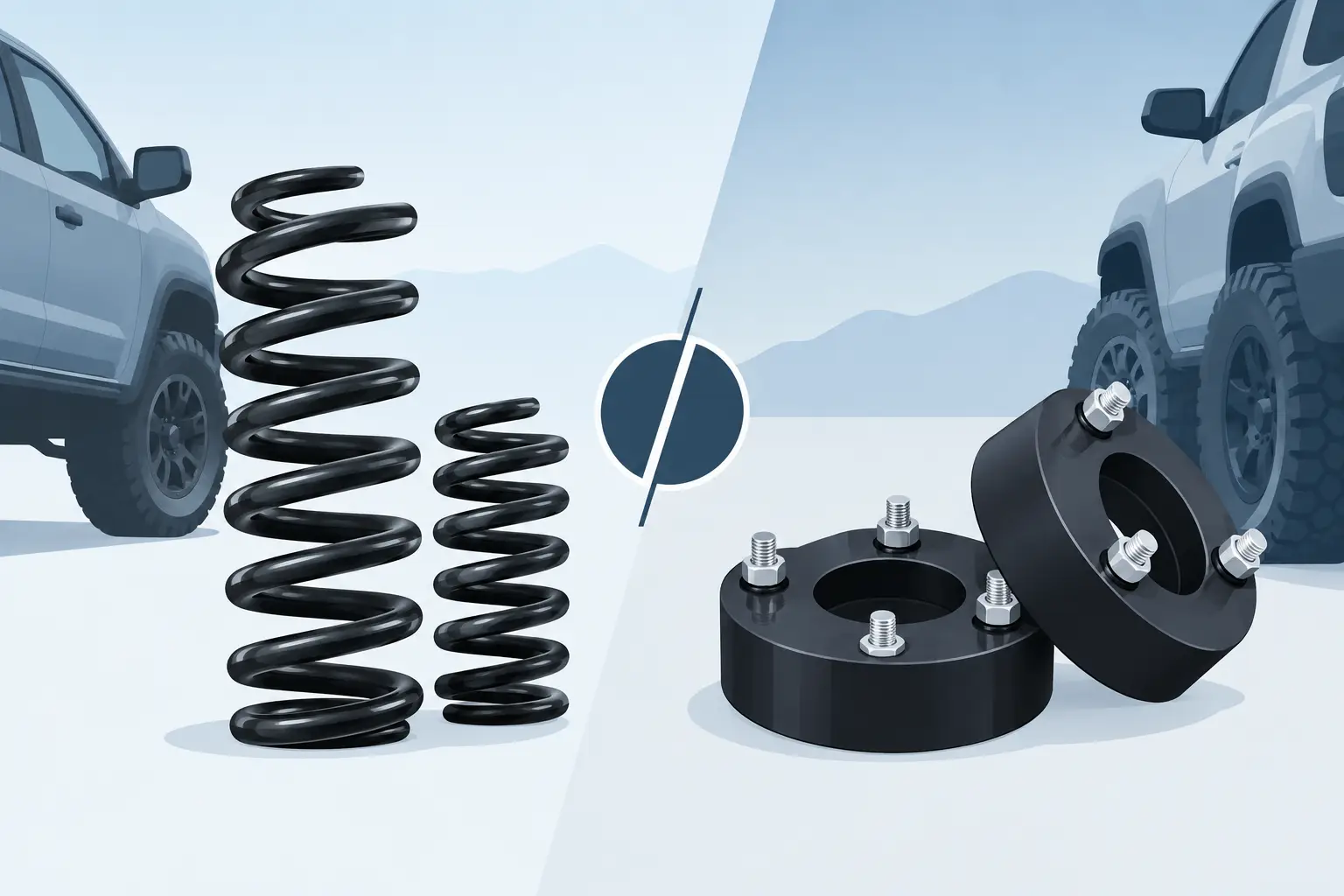
A lift can change far more than the view over the hood. It affects how your truck, Jeep, or SUV carries cargo, corners on pavement, clears tires, and behaves over broken ground. In the coil springs vs lift spacers decision, the right answer comes down to what you expect from the vehicle after the lift is installed, not simply how much height you want.
Lift spacers offer a fast, cost-conscious way to raise many coil-spring suspension vehicles. Replacement or lift coil springs take a more complete approach, changing the spring itself to support a specific ride height and, often, a specific load range. Both can be the right choice. The mistake is treating them as interchangeable.
Coil Springs vs Lift Spacers: The Core Difference
A lift spacer sits above or below the factory coil spring, depending on the vehicle and kit design. It repositions the spring assembly to raise the body and frame relative to the axles and wheels. The factory spring remains in place, so its spring rate and load behavior generally remain unchanged.
A lift coil spring replaces the original spring with one built for a taller installed height. Many upgraded springs also use a revised spring rate. That means the spring can be designed to handle added front-end weight, towing accessories, trail gear, or a more controlled ride at the new height.
This is the practical distinction: spacers create height by relocating the existing spring, while lift springs create height through a new spring design. A spacer lift is usually about clearance and appearance. A coil spring lift can address height, support, and suspension behavior together.
When Lift Spacers Make Sense
Lift spacers are a strong option for drivers who want a moderate lift without replacing parts that are still in good condition. They are commonly used to level a truck with a nose-down factory stance, make room for slightly larger tires, or give a daily driver a more purposeful profile.
Their main advantage is efficiency. Spacer kits are typically less expensive than replacement spring kits, and installation can be straightforward for an experienced DIY owner or a suspension shop. On a vehicle with healthy factory springs, a spacer can deliver the stance change you want while retaining the familiar factory ride feel.
That last point has a limit. Retaining the factory spring rate is beneficial only if the vehicle still operates near its original weight. Add a steel bumper, winch, skid plates, rooftop gear, or a heavy cargo setup, and the original coils may sag or feel under-supported. A spacer does not restore lost spring capacity. It simply raises the vehicle around the same spring.
Spacers also demand attention to geometry. Raising the vehicle changes control-arm angles, shock travel, steering angles, and alignment settings. A small leveling spacer may work cleanly with stock-length components, but taller applications can require corrected control arms, extended shocks, sway-bar links, track-bar adjustments, or other supporting hardware. The kit height alone does not tell the whole fitment story.
When Lift Coil Springs Are Worth It
Choose lift coil springs when the vehicle has to do more than look taller. They are the better match for SUVs and trucks that routinely carry equipment, tow within their rated limits, run heavy aftermarket accessories, or see consistent off-road use.
A properly selected spring can maintain ride height under added load rather than compressing and leaving the front or rear low. For example, a Jeep with a winch and steel front bumper may need a spring designed for that extra weight. Installing a generic spacer over worn factory coils can produce the advertised height at first, then settle unevenly as the original springs continue to fatigue.
Lift springs can also improve control, but stiffer is not automatically better. A higher spring rate may reduce bottoming and body movement under load, yet it can make an unloaded vehicle feel firmer over expansion joints and rough pavement. Progressive-rate springs can offer a more compliant initial response while adding support deeper into the suspension travel, but results vary by vehicle design and spring selection.
The best coil spring setup matches the real vehicle, not an idealized build. Be honest about the accessories already installed, the cargo you carry, and whether the vehicle spends most of its time commuting, towing, or traveling off pavement. A spring engineered for constant heavy weight can feel excessive on an empty daily driver.
Ride Quality, Handling, and Load Capacity
Ride quality is where the coil springs vs lift spacers comparison becomes more nuanced. Because a spacer typically retains the factory coil, it can preserve much of the stock spring feel. That makes it attractive for a lightly modified street-driven SUV. However, a taller ride height still changes the vehicle’s center of gravity and suspension angles, so it will not drive exactly like stock.
Replacement lift springs may improve composure when their rate and free length are matched to the vehicle. They can reduce sag, support accessory weight, and provide more predictable behavior on uneven terrain. The trade-off is that a mismatched spring can make the ride too firm, too soft, or unbalanced from front to rear.
Neither option eliminates the need for quality shocks. Springs support the vehicle’s weight. Shocks control the movement of those springs. If you install a lift spacer or taller coil spring without confirming shock travel, the suspension may top out, bottom out, or lose usable droop travel. For a lift intended for trails or heavy use, matching shocks are often as critical as the springs themselves.
Tire Clearance Is More Than Lift Height
Many buyers install a lift to clear larger tires, but clearance depends on wheel offset, tire width, tire diameter, steering lock, and suspension compression. A 2-inch lift does not guarantee that a particular tire size will clear on every truck, Jeep, or SUV.
A tire can clear while parked and still rub the fender liner, bumper edge, sway bar, or control arm during a full turn or when the suspension compresses. Wheel backspacing can move the tire farther outward for control-arm clearance, but too much outward position can increase fender contact and place additional leverage on wheel bearings and steering components.
Before choosing springs or spacers, verify the intended tire and wheel package for your exact year, make, model, trim, drivetrain, and suspension configuration. Factory options can change brake, axle, and suspension details enough to affect fitment.
Supporting Parts You Should Plan For
A lift should be treated as a system, especially beyond a mild leveling height. The higher you go, the more likely you are to need parts that restore geometry and preserve safe operation. Depending on the application, that can include alignment hardware, longer shocks, adjustable track bars, control arms, bump-stop extensions, brake-line brackets, sway-bar links, or driveline corrections.
Use this practical check before ordering:
- Confirm the lift height at both the front and rear, not just the advertised maximum.
- Check whether your vehicle has factory sag, added accessories, or constant cargo weight.
- Verify shock length and available travel at full extension and compression.
- Budget for a professional alignment after installation.
- Confirm tire, wheel, and backspacing fitment at full steering lock.
Alignment is not optional after changing ride height. Camber, caster, and toe affect tire wear, steering return, stability, and braking confidence. A vehicle that looks level in the driveway can still be poorly aligned on the road.
Cost, Installation, and Long-Term Value
Lift spacers usually win on initial cost. They can be an efficient way to improve stance or obtain modest tire clearance without purchasing complete replacement springs. For a lightly used daily driver on healthy factory coils, that value is hard to ignore.
Coil springs cost more because they replace a major load-bearing component and are often engineered for a specific height and weight range. Their value becomes clearer when they prevent recurring sag, improve loaded stability, or avoid paying twice after a spacer setup proves inadequate for the vehicle’s actual use.
Installation labor can be similar because both options often require disassembling strut or coil assemblies. Some vehicles need spring compressors and careful handling of stored spring energy. If you do not have the correct tools, torque specifications, and experience, professional installation is the smart call. Suspension work is not the place to improvise.
FORTLUFT customers building for function and finish should approach a lift the same way they choose wheels, tires, or exhaust components: fitment first, then the look. A clean stance means more when the vehicle remains controlled, capable, and ready for the miles ahead.
Choose for How You Actually Drive
Pick lift spacers if you want a modest height increase, your factory springs are in good condition, and your vehicle does not carry significant added weight. They are a practical solution for leveling, appearance, and mild tire clearance.
Choose lift coil springs if you need to support accessories or cargo, correct worn or sagging original coils, improve off-road suspension performance, or build around a more demanding use case. The added cost is often justified by a setup that holds its height and handles weight as intended.
The best lift is not the tallest one or the cheapest one. It is the one that leaves your vehicle looking right, driving confidently, and prepared for the load and terrain waiting beyond the driveway.